Table of Contents
- 1. Chirinjit Lal v. Union of India (AIR 1951 SC 41)
- 2. D.S. Nakara v. Union of India (AIR 1983 SC 130)
- 3. E.P. Royappa v. State of Tamil Nadu (AIR 1974 SC 555)
- 4. Indian Nehru Gandhi v. Raj Narayan (AIR 1975 SC 2299)
- 5. Mrs. X v. Registrar General, High Court of M.P. (2022 SCC OnLine (SC) 171)
- 6. National Legal Services Authority v. Union of India (AIR 2014 SC 1863)
- 7. Public Political Party v. Union of India (2024 INSC 113)
- 8. R. Muthukumar v. Chairman and Managing Director TANGEDCO (2022 INSC 157)
- 9. R.K. Garg v. Union of India (AIR 1981 SC 2138)
- 10. State of West Bengal v. Anwar Ali Sarkar (AIR 1952 SC 75)
- 11. State of West Bengal v. Anwar Ali Sarkar (AIR 1952 SC 75)
- 12. Veena Vadini Teachers Training Institute v. State of Madhya Pradesh and Ors. (2023 SCC OnLine SC 535)
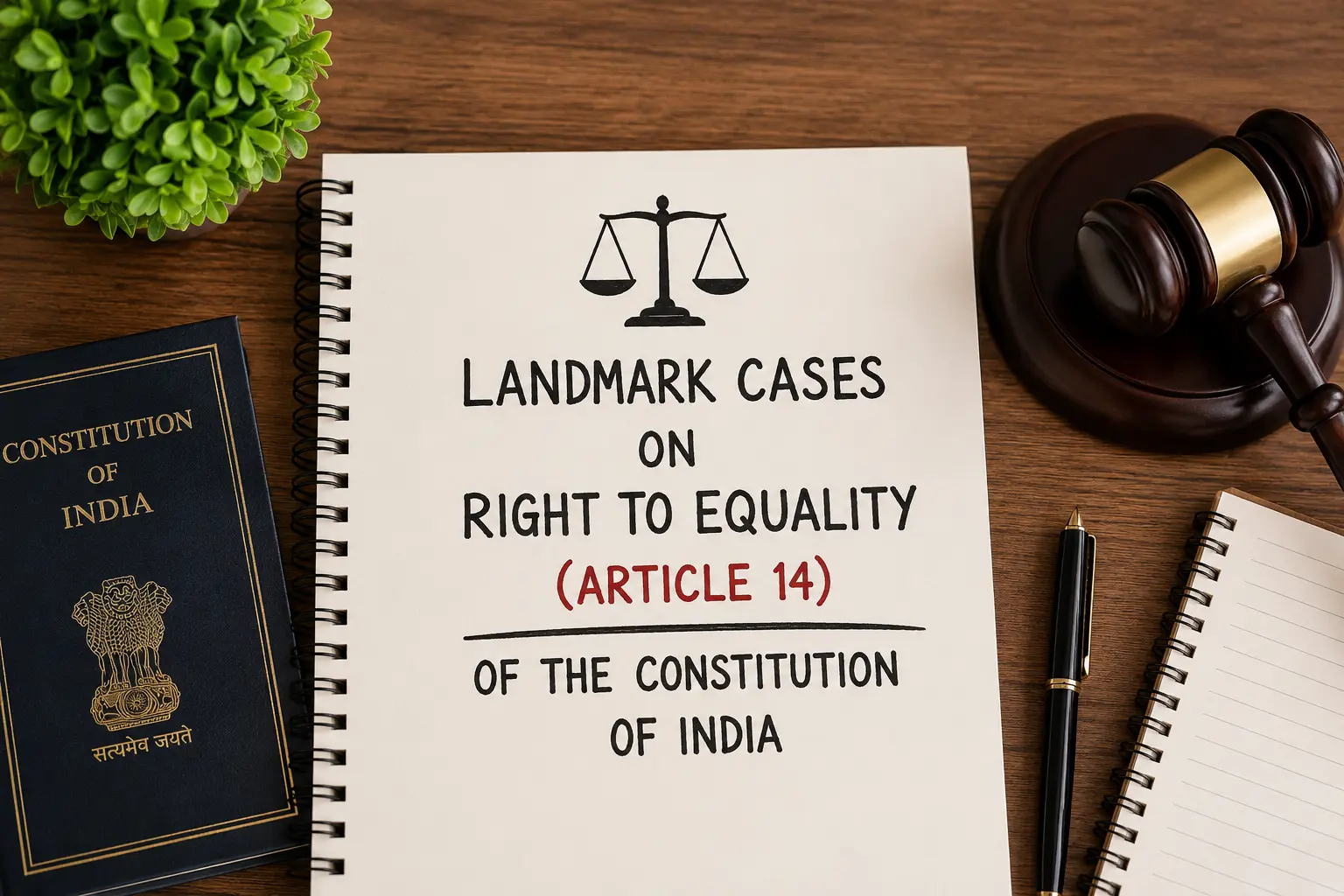
Article 14 of the Constitution of India guarantees equality before the law and equal protection of the laws. Over the years, the Supreme Court has interpreted this provision through several landmark judgments, laying down important principles relating to reasonable classification, arbitrariness, rule of law, judicial review, reservation, equality for transgender persons, and constitutional validity of State action. The following landmark cases are essential for understanding the scope and evolution of the Right to Equality under Article 14.
1. Chirinjit Lal v. Union of India (AIR 1951 SC 41)
Held:
Supreme Court held that law may be constitutional even though it applies to a single individual on account of special circumstances. That single individual may be treated as a class. The presumption of constitutionality is always in favour of the statute and the person who challenges the constitutionality has to show that law is arbitrary and unreasonable.
2. D.S. Nakara v. Union of India (AIR 1983 SC 130)
Held:
Supreme Court held that doctrine of classification was evolved to sustain a legislation to State in order to help weaker sections of society.
3. E.P. Royappa v. State of Tamil Nadu (AIR 1974 SC 555)
Held:
Article 14 spells the traditional concept of equality which is based on reasonable classification. Supreme Court laid down a new concept of equality which is different from traditional concept of reasonable classification. Article 14 strikes at the arbitrariness in State action and ensures fairness and equality of treatment. Principle of reasonableness pervades Article 14.
4. Indian Nehru Gandhi v. Raj Narayan (AIR 1975 SC 2299)
Held:
Supreme Court held that Rule of Law embodied in Article 14 of the Constitution is the basic feature of the Constitution and it cannot be destroyed by the amendment of the Constitution.
5. Mrs. X v. Registrar General, High Court of M.P. (2022 SCC OnLine (SC) 171)
Held:
There is a presumption of validity of the State Action. The burden is on the person who alleges violation of Article 14 of the Constitution of India to prove that State action was violative of Article 14. The scope of judicial review is limited only to satisfy that the State action is not vitiated by the vice of arbitrariness. It is not for the courts to recast the policy or to substitute it with another which is considered to be more appropriate.
6. National Legal Services Authority v. Union of India (AIR 2014 SC 1863)
Held:
It was held that the Members of Transgender community (neither males nor females) should be treated as Third Gender. They are entitled to equal rights like any other citizen of India. Discrimination on the basis of sexual orientation or gender identity includes any discrimination, exclusion restriction or preference, which has the effect of nullifying or transposing equality by the law or the equal protection of laws guaranteed under our Constitution.
7. Public Political Party v. Union of India (2024 INSC 113)
Held:
Supreme Court held that a Deputy Chief Minister is, first and foremost, a Minister in the Government of the State. The appellation of a Deputy Chief Minister does not breach the constitutional position, namely, that a person who holds office of a Minister must, in any event, within a stipulated period, be the Member of the legislature in order to qualify for appointment as a Minister. Thus, Supreme Court dismissed a PIL challenging the appointment of Deputy Chief Ministers in various states as being violative of Article 14.
8. R. Muthukumar v. Chairman and Managing Director TANGEDCO (2022 INSC 157)
Held:
There cannot be a negative equality. If a benefit is conferred on some people without any legal basis or justification then it cannot be a ground to claim parity by others.
9. R.K. Garg v. Union of India (AIR 1981 SC 2138)
Held:
Supreme Court held that Article 14 forbids class-legislation but it does not prohibit reasonable classification.
10. State of West Bengal v. Anwar Ali Sarkar (AIR 1952 SC 75)
Held:
Supreme Court held that the expression 'equal protection of laws' is a corollary to the expression 'equality before law' and it is difficult to imagine a situation in which the violation of the equal protection of law will not be the violation of equality before law.
11. State of West Bengal v. Anwar Ali Sarkar (AIR 1952 SC 75)
Held:
Supreme Court held that differentia which is the basis of the classification and the object of the Act are two different things. It is important to have nexus between the basis of classification and the object of the Act.
12. Veena Vadini Teachers Training Institute v. State of Madhya Pradesh and Ors. (2023 SCC OnLine SC 535)
Held:
Supreme Court held that though reservation in favour of residents is permissible, yet reservation to the extent of 75% of the total seats making it a wholesale reservation, is unconstitutional and violative of Article 14 of the Constitution of India and asked M.P. government to revise its 75% domicile quota in B.Ed. seats.