Table of Contents
- 1. Directorate of Revenue Intelligence v. Raj Kumar Arora (2025 INSC 498)
- 2. Jastvinder Saini v. State (Govt. of NCT of Delhi) (2013) 7 SCC 256)
- 3. Kalicharan v. State of Uttar Pradesh (2021 SCC OnLine (SC) 773)
- 4. Mala Singh v. State of Haryana (2019) 5 SCC 127)
- 5. Nallapareddy Sridhar Reddy v. State of A.P. (2020) 12 SCC 467)
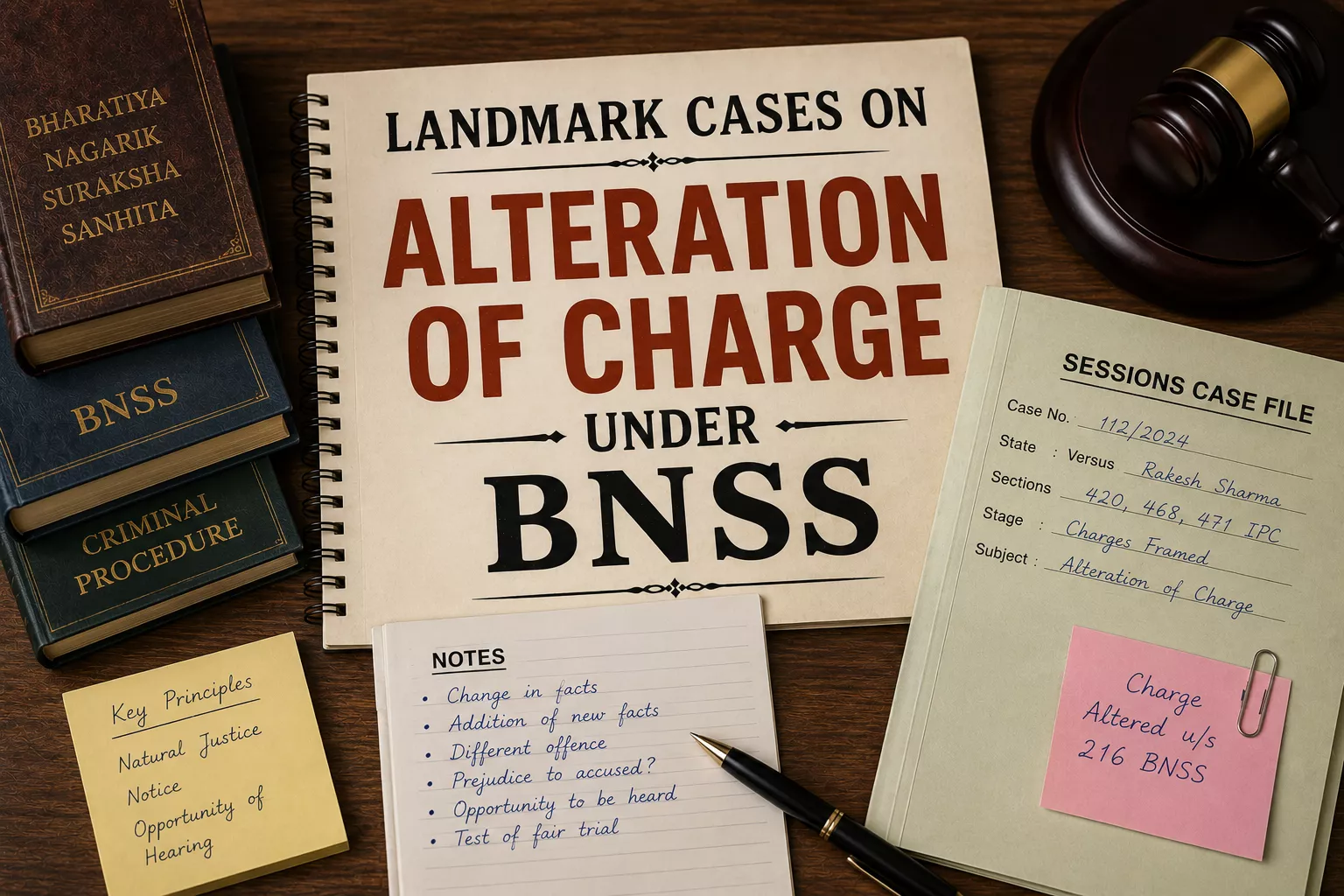
The following landmark judgments explain the legal principles governing the alteration or addition of charges under the Bharatiya Nagarik Suraksha Sanhita (BNSS). These decisions clarify the powers of the Trial Court and Appellate Court to alter or add charges, the effect of omission to frame a charge, the requirement of prejudice to the accused, and the stage at which charges may be modified.
1. Directorate of Revenue Intelligence v. Raj Kumar Arora (2025 INSC 498)
Held: Section 216 Cr.P.C. (Section 239 of BNSS) addition or alteration of charge under this provision only the power to delete charges already framed by the Trial Court under Section 228 Cr.P.C. (now Section 251 of BNSS). Once charges are framed, the accused cannot be discharged under Sections 227 or 226 Cr.P.C. (now Sections 250 or 239 of BNSS), and the trial must proceed to either conviction or acquittal.
2. Jastvinder Saini v. State (Govt. of NCT of Delhi) (2013) 7 SCC 256)
Held: It was held that the Code gives ample power to the court to alter or amend a charge whether by the trial court or by the appellate court.
3. Kalicharan v. State of Uttar Pradesh (2021 SCC OnLine (SC) 773)
Held: It was held that when the Court of appeal is called upon to decide whether any failure of justice has been occasioned due to omission to frame a charge or error in the charge, the Court is duty bound to examine the entire record of the trial including all exhibited documents, depositions and the statements of the accused recorded under Section 313 Cr.P.C. (now Section 351 of BNSS).
4. Mala Singh v. State of Haryana (2019) 5 SCC 127)
Held: It was held that A combined reading of Sections 216, 386 and 464 of Cr.P.C. (now Sections 239, 427 and 510 of BNSS) would reveal that an alteration of charge where no prejudice is caused to the accused or the prosecution is well within the powers and jurisdiction of the court including appellate court. It is only when any omission to frame charge initially or till culmination of the proceedings or at the appellate stage results in failure of justice or causes prejudice, the same may result in vitiating the trial in appropriate case.
5. Nallapareddy Sridhar Reddy v. State of A.P. (2020) 12 SCC 467)
Held: It was held that the alteration and addition of a charge may be done, if in the opinion of the court there was omission in the framing of charge or if upon prima facie examination of the materials brought on record, it leads the court to form a presumptive opinion as to the existence of factual ingredients constituting the offence. The test to be adopted by the court is that the material brought on record needs to have a direct link or nexus with the ingredients of alleged offence.
6. S. Nitheen & Ors. v. State of Kerala & Anr. (2024 INSC 420)
Held: Supreme Court held that no person other than the spouse to the second marriage could have been charged for the offence punishable under Section 494 IPC (now Section 82(1) of BNSS) simpliciter. However, this is a curable defect, and the charge can be altered at any stage as per the provisions of Section 216 Cr.P.C. (now Section 239 of BNSS)