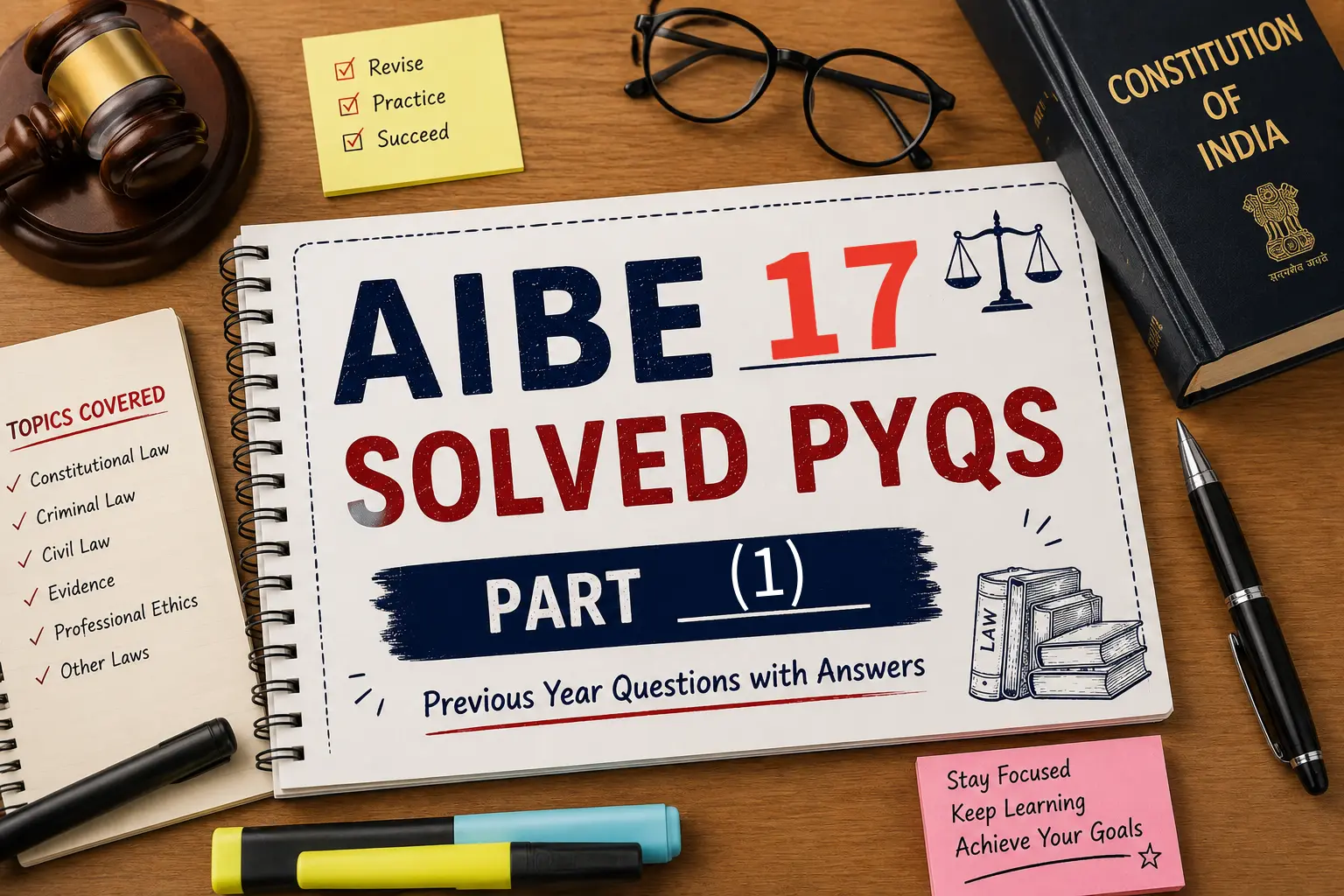
Practice the AIBE 17 (2023) Solved Question Paper with all 100 original multiple-choice questions and official answer key-based solutions. An excellent resource for AIBE preparation and revision.
Q1. The title of the Constitution of India is laid down in:
(A) Article 1
(B) Article 5
(C) Article 390
(D) Article 393
Answer: D
Q2. Constitutional provisions of Fundamental Rights (FRs) are given under which part of the Constitution of India?
(A) Part II
(B) Part II
(C) Part III
(D) Part IV
Answer: (C)
Q3. By which of the following Amendment Act of 1985, Anti Defection Law was added in the Constitution of India?
(A) 51st Constitutional Amendment
(B) 52nd Constitutional Amendment
(C) 53rd Constitutional Amendment
(D) 54th Constitutional Amendment
Answer: (B)
Q4. In which one of the following cases the Supreme Court decided that, a constitutional amendment is a 'law' within the meaning of Article 13(2) and therefore if it violates any of the fundamental rights it may be declared void?
(A) Sajjan Singh v. State of Rajasthan
(B) Keshavananda Bharati v. State of Kerala
(C) Indra Sawhney v. Union of India
(D) Golak Nath v. State of Punjab
Answer: (D)
Q5. Uniform Civil Code in India is:
(A) Fundamental Rights
(B) Directive Principles of State Policy
(C) Government Policy
(D) Constitutional Right
Answer: (B)
Q6. As per Article 16, No citizen shall, on grounds only of ________ or any of them, be ineligible for, or discriminated against in respect of, any employment or office under the State.
(A) religion, race, caste, sex, descent, place of birth, residence
(B) religion, age, caste, sex, descent, place of birth, residence
(C) religion, race, age, sex, descent, place of birth, residence
(D) religion, race, caste, sex, descent, place of birth, age
Answer: (A)
Q7. The minimum number of Judges who are to sit for the purpose of deciding any case involving a substantial question of law as to the interpretation of this Constitution or for the purpose of hearing any reference under Article 143 shall be ________.
(A) 2
(B) 3
(C) 4
(D) 5
Answer: (D)
Q8. According to Article 300A of the Constitution of India, No ________ shall be deprived of his property save by authority of law.
(A) person
(B) citizen
(C) foreigner
(D) Indian
Answer: (A)
Q9. Which of the following is not 'Law' according to Article 13 of Indian Constitution?
(A) Rule
(B) By-laws
(C) Custom or usage
(D) None of these
Answer: D
Q10. Which of the following Schedule deals with Union list, State list and Concurrent list in the Constitution of India?
(A) Schedule 7
(B) Schedule 10
(C) Schedule 11
(D) Schedule 12
Answer: (A)
Q11. Under Sections 82 and 83 of Indian Penal Code, an offence is punishable if it is done by a child.
(A) of below seven years of age.
(B) of above seven years of age but below twelve years having attained sufficient maturity and understanding.
(C) of above seven years of age but below ten years having attained sufficient maturity and understanding.
(D) of above seven years of age but below twelve years not having attained sufficient maturity and understanding.
Answer: (B)
Q12. Name two essential conditions of Penal Liability.
(A) Guilty Body & Rightful Act
(B) Guilty Intent & Wrong Motive
(C) Guilty Mind & Wrongful Act
(D) Guilty Motive and Wrongful Act
Answer: (C)
Q13. Provision for Right of Private Defence is given between ________ of IPC.
(A) Sections 74-84
(B) Sections 96-106
(C) Sections 107-120
(D) Sections 141-160
Answer: (B)
Q14. The consent is not a valid consent under Section 90 of IPC.
(A) If given under fear of injury or misconception of fact.
(B) If given by person of unsound mind.
(C) If given by child below 12 years of age.
(D) All of these.
Answer: (D)
Q15. Causing of the death of child in the mother's womb is not homicide as provided under
(A) Explanation III to Section 300
(B) Explanation III to Section 299
(C) Explanation III to Section 301
(D) Explanation III to Section 302
Answer: (B)
Q16. Punishment for defamation under the Indian Penal Code is simple imprisonment for a term which may extend to ________ or with fine or with both.
(A) 2 Years
(B) 3 Years
(C) 4 Years
(D) 5 Years
Answer: (A)
Q17. Assault or criminal force to woman with intent to outrage her modesty under IPC is which kind of offence?
(A) Non-Cognizable and Bailable
(B) Cognizable and Bailable
(C) Cognizable and Non-Bailable
(D) Non-Cognizable and Non-Bailable
Answer: (C)
Q18. 'A' places men with firearms at the outlets of a building and tells 'Z', that they will fire at 'Z', if 'Z' attempts to leave the building. 'A' is guilty of:
(A) Wrongful confinement
(B) Wrongful restraint
(C) Both wrongful confinement and wrongful restraint
(D) None of these
Answer: (C)
Q19. The provision of 'Plea Bargaining' under Chapter XXIA of Cr.P.C. are not applicable if the offence is committed against a child below the age of
(A) 12 years
(B) 14 years
(C) 16 years
(D) 18 years
Answer: (B)
Q20. Section 125 of the Criminal Procedure Code is "SECULAR" in character was observed in which of the following case?
(A) Lalita Kumari v. State of Uttar Pradesh
(B) Arnesh Kumar's Case
(C) Mohd. Ahmed Khan v. Shah Bano Begum
(D) Selvi v. State of Karnataka
Answer: (C)
Q21. Who has the power of summary trial of a case?
(A) Chief Judicial Magistrate
(B) Metropolitan Magistrate
(C) Any Magistrate of first class specially empowered by the High Court
(D) All of these
Answer: (D)
Q22. Which Sections deal with the processes to compel appearance under Code of Criminal Procedure, 1973?
(A) Sections 61 to 90
(B) Sections 154 to 173
(C) Sections 211 to 219
(D) Sections 274 to 282
Answer: (A)
Q23. An officer for which, a police officer may arrest a person without warrant?
(A) Non-cognizable offence
(B) Cognizable offence
(C) Non-bailable offence
(D) None of these
Answer: (B)
Q24. In a summons trial case instituted on a complaint wherein the summons has been issued to the accused, the non-appearance of the complainant shall entail:
(A) Discharge of the accused
(B) Acquittal of the accused
(C) Either discharge or acquittal depending on the facts and circumstances of the case
(D) None of these
Answer: (B)
Q25. Suppose F.I.R. is not registered by the Station House Officer. What are the options that the complainant has?
(A) Approach Superintendent of Police.
(B) Approach Magistrate by filing Private Complaint.
(C) None of these.
(D) Both (Approach Superintendent of Police) & (Approach Magistrate by filing Private Complaint).
Answer: (D)
Q26. Any police officer making an investigation under Section 160 of Cr.P.C. cannot require the attendance of a male, at a place other than the place of his residence who is:
(A) under the age of 15 years and above the age of 60 years
(B) under the age of 18 years and above the age of 60 years
(C) under the age of 15 years and above the age of 65 years
(D) under the age of 18 years and above the age of 65 years
Answer: (C)
Q27. If someone lies before the court on affidavit, how it can be tackled by the Advocate/s?
(A) Perjury Application can be filed.
(B) Withdraw from the case.
(C) File application to support that.
(D) Pay the fine for the same.
Answer: (A)
Q28. Proclamation for person absconding shall be published as follows:
(i) It shall be publicly read in some conspicuous place of the town or village in which such person ordinarily resides;
(ii) It shall be affixed to some conspicuous part of the house or homestead in which such person ordinarily resides or to some conspicuous place of such town or village;
(iii) A copy thereof shall be affixed to some conspicuous place of the Court-house;
(iv) The Court may also, if it thinks fit, direct a copy of the proclamation to be published in a daily newspaper circulating in the place in which such person ordinarily resides.
(A) Only ii, iii, iv are correct.
(B) Only i and iii are correct.
(C) Only i, ii, iii are correct.
(D) All i, ii, iii, iv are correct.
Answer: (D)
Q29. Which Order of Civil Procedure Code deals with Temporary Injunction and Interlocutory Injunction?
(A) Order 38
(B) Order 39
(C) Order 40
(D) Order 41
Answer: (B)
Q30. A is a tradesman in Ahmedabad, B carries on business in Delhi. B, by his agent in Ahmedabad, buys goods of A and requests A to deliver them to the Western Roadways Transport Company. A delivers the goods accordingly in Ahmedabad. A may sue B for the price of the goods:
(A) In Ahmedabad only
(B) In Delhi only
(C) In either Ahmedabad or Delhi
(D) Anywhere in India
Answer: (C)
Q31. Which of the following Section of Civil Procedure Code deals with the concept of Res Judicata?
(A) Section 10
(B) Section 11
(C) Section 12
(D) Section 13
Answer: (B)
Q32. Mr. X, Mr. Y and Mr. Z are jointly and severally liable for ₹10,000 under a decree obtained by Mr. A. Mr. Y obtains a decree for ₹10,000 against Mr. A singly and applies for execution to the Court in which the joint-decree is being executed. Which of the following option is correct for Mr. A?
(A) Mr. A may treat his joint-decree as cross-decree under Order 21 Rule 18.
(B) Mr. A cannot treat his joint-decree as cross-decree under Order 21 Rule 18.
(C) Mr. A cannot treat his joint-decree as cross-decree under Order 22 Rule 18.
(D) None of these.
Answer: (A)
Q33. A, B and C are coparceners of Joint Hindu Family. They jointly execute a mortgage in favour of Y. Y files a suit against all of them. Summons is served to C but not to A and B. None of them appears and an ex parte decree is passed against all. A and B applied to set aside the ex parte decree. The decree will be set aside against:
(A) Only C
(B) Only A & B
(C) A, B and C
(D) None of these
Answer: (C)
Q34. Which of the following provision of Civil Procedure Code, 1908 deals with the Institution of Suits?
(A) Section 22
(B) Section 24
(C) Section 26
(D) Section 28
Answer: (C)
Q35. Defendant shall, within ________ days from the date of service of summons on him, present a Written Statement of his defence (ORDER VIII):
(A) 15
(B) 30
(C) 60
(D) 45
Answer: (B)
Q36. Which of the following statement is incorrect?
(A) First appeal can be on question of fact or law or both.
(B) Second appeal can be on substantial question of law only.
(C) Second appeal can be on question of fact or law or both.
(D) First appeal may or may not be in the High Court, Second appeal has to be in the High Court.
Answer: (C)
Q37. As per Order VI, Pleading shall mean?
(A) Plaint
(B) Written Statement
(C) Both Plaint and Written Statement
(D) None of these
Answer: (C)
Q38. Which of the following Order deals with "Death, Marriage and Insolvency of Parties"?
(A) Order 20
(B) Order 21
(C) Order 22
(D) Order 23
Answer: (C)
Q39. The doctrine of 'Res Gestae' has been discussed in which Section of the Evidence Act?
(A) Section 5
(B) Section 6
(C) Section 10
(D) Section 11
Answer: (B)
Q40. When the liability of a person who is to one of the parties to the suit depends upon the liability of a stranger to the suit, then an admission by the stranger in respect of his liability shall be an admission on the part of that person who is a party to the suit. It has been so provided under which Section of the Indian Evidence Act, 1872?
(A) Section 17
(B) Section 18
(C) Section 19
(D) Section 21
Answer: (C)
Q41. Judicial Evidence means:
(A) Evidence received by Courts in proof or disproof of facts
(B) Evidence received by Police Officer
(C) Evidence received by Home Department
(D) Evidence received by Tribunal
Answer: (A)
Q42. Which of the following is not a 'document' according to the Indian Evidence Act, 1872?
(A) An inscription on a metal plate or stone
(B) A map or plan
(C) A caricature
(D) None of these
Answer: (D)
Q43. "Presumptions as to Dowry Deaths" is given under which Section?
(A) 113A
(B) 113B
(C) 114A
(D) 114B
Answer: (B)
Q44. Which of the following is not 'Secondary evidence' as per Section 63 of Indian Evidence Act, 1872?
(A) Copies made from the original by mechanical processes which in themselves ensure the accuracy of the copy, and copies compared with such copies.
(B) Copies made from or compared with the original.
(C) Oral accounts of the contents of a document given by some person who has himself seen it.
(D) Copies not certified under Section 63.
Answer: (D)
Q45. A leading question may be asked in:
(A) Examination-in-chief
(B) Re-examination
(C) Cross examination
(D) None of these
Answer: (C)
Q46. Extra Judicial Confession means:
(A) Confessions made either to Police or person other than Judges and Magistrates.
(B) Confessions made before Magistrates.
(C) Confessions made before Judges.
(D) None of these.
Answer: (A)
Q47. The Arbitral Tribunal shall not be bound by ________ in the determination of rules of procedure.
(A) The Code of Civil Procedure, 1908
(B) The Indian Evidence Act, 1872
(C) The Code of Criminal Procedure, 1973
(D) Both, (The Code of Civil Procedure, 1908) and (The Indian Evidence Act, 1872)
Answer: (D)
Q48. Which of the following Section deals with "Arbitration Agreement" in Arbitration and Conciliation Act, 1996?
(A) Section 6
(B) Section 7
(C) Section 8
(D) Section 9
Answer: (B)
Q49. Under what circumstances the arbitral proceedings can be terminated?
(1) Final Arbitral award
(2) Interim award
(3) Where the arbitral tribunal issues an order for the termination
(A) 1 and 3
(B) 1 and 2
(C) 2 and 3
(D) 1, 2 and 3
Answer: (A)
Q50. Under Section 29 of The Arbitration and Conciliation Act, 1996 arbitral proceedings with more than one arbitrator, any decision of the arbitral tribunal ________.
(A) shall be made by all members
(B) shall be made by 2/3 majority of its members
(C) shall be made by the chief arbitrator
(D) shall be made by majority of its members
Answer: (D)
PART 2 :- Click Here