Table of Contents
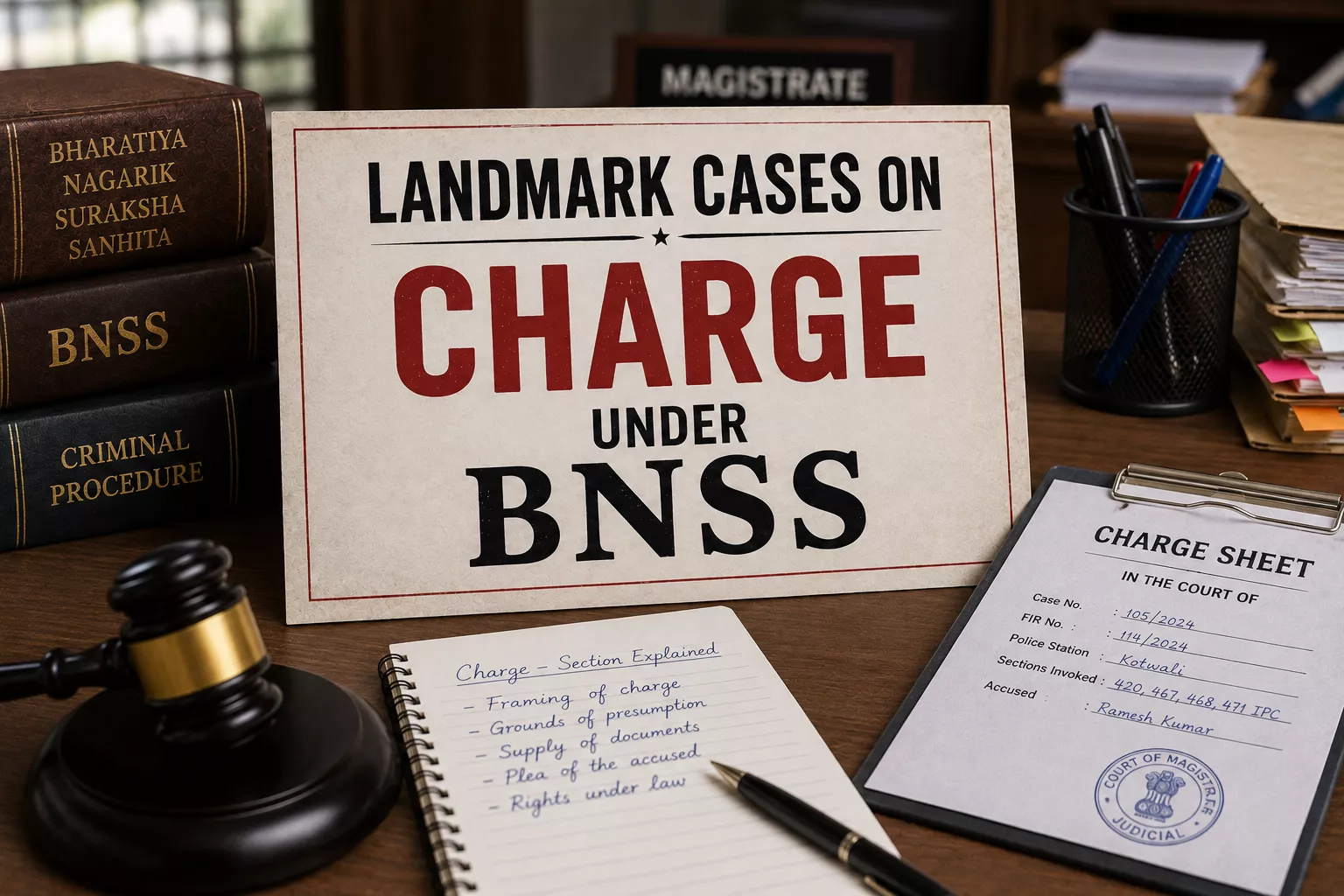
The following landmark judgments explain the legal principles governing the framing of charge under the Bharatiya Nagarik Suraksha Sanhita (BNSS). These decisions discuss the meaning, object, purpose, and requirements of a charge, the duty of the Trial Court while framing charges, and the necessity of informing the accused of the precise allegations against him.
1. Birichh Bhuian v. State of Bihar (AIR 1963 SC 1120)
Held: It was held that Charge can be defined as a precise formulation of specific accusation made against a person of an offence alleged to have been committed by him.
2. Sohan Lal alias Sohan Singh v. State of Punjab (AIR 2003 SC 4466)
Held: It was held that Section 211 of the Cr.P.C. (now Section 234 of BNSS), mandates that the charge against the accused must be clearly stated. Additionally, as per Sub-section (4) of Section 211 (now Section 234(4) of BNSS), the charge must specify the law and the relevant section under which the offence is alleged to have been committed.
3. Somdarajan v. State (2023 SCC OnLine SC 424)
Held: Supreme Court observed that the Trial Courts ought to be very meticulous when it comes to framing of charges.
4. V.C. Shukla v. State (AIR 1980 SC 962)
Held: It was held that the charge serves as a purpose of note or intimation to the accused, giving a clear and unambiguous notice of the nature of accusation. It is to enable the accused to have a clear idea of what he is being tried for. It is an important step in criminal trial and it separates the stage of inquiry from trial.
5. Willie (William) Slaney v. State of M.P. (AIR 1956 SC 116)
Held: It was held that the object of the charge is to give accused notice of the matter he is charged with. If the necessary information is conveyed to him and no prejudice is caused to him because of the charges, the accused cannot succeed merely by showing that the charges framed were defective.