Table of Contents
- 1. A.D.M., Jabalpur v. Shivkant Shukla (AIR 1976 SC 1207)
- 2. Minerva Mills Ltd. v. Union of India (AIR 1980 SC 1789)
- 3. Minerva Mills Ltd. v. Union of India (AIR 1980 SC 1789)
- 4. Rameshwar Prasad v. Union of India (2006) 2 SCC 1)
- 5. S.R. Bommai v. Union of India (1994) 3 SCC 1)
- 6. Shree Meenakshi Mills Ltd. v. Union of India (AIR 1974 SC 366)
- 7. Union of India v. Pesticides Manufacturing and Formulators Association of India (AIR 2003 SC 87)
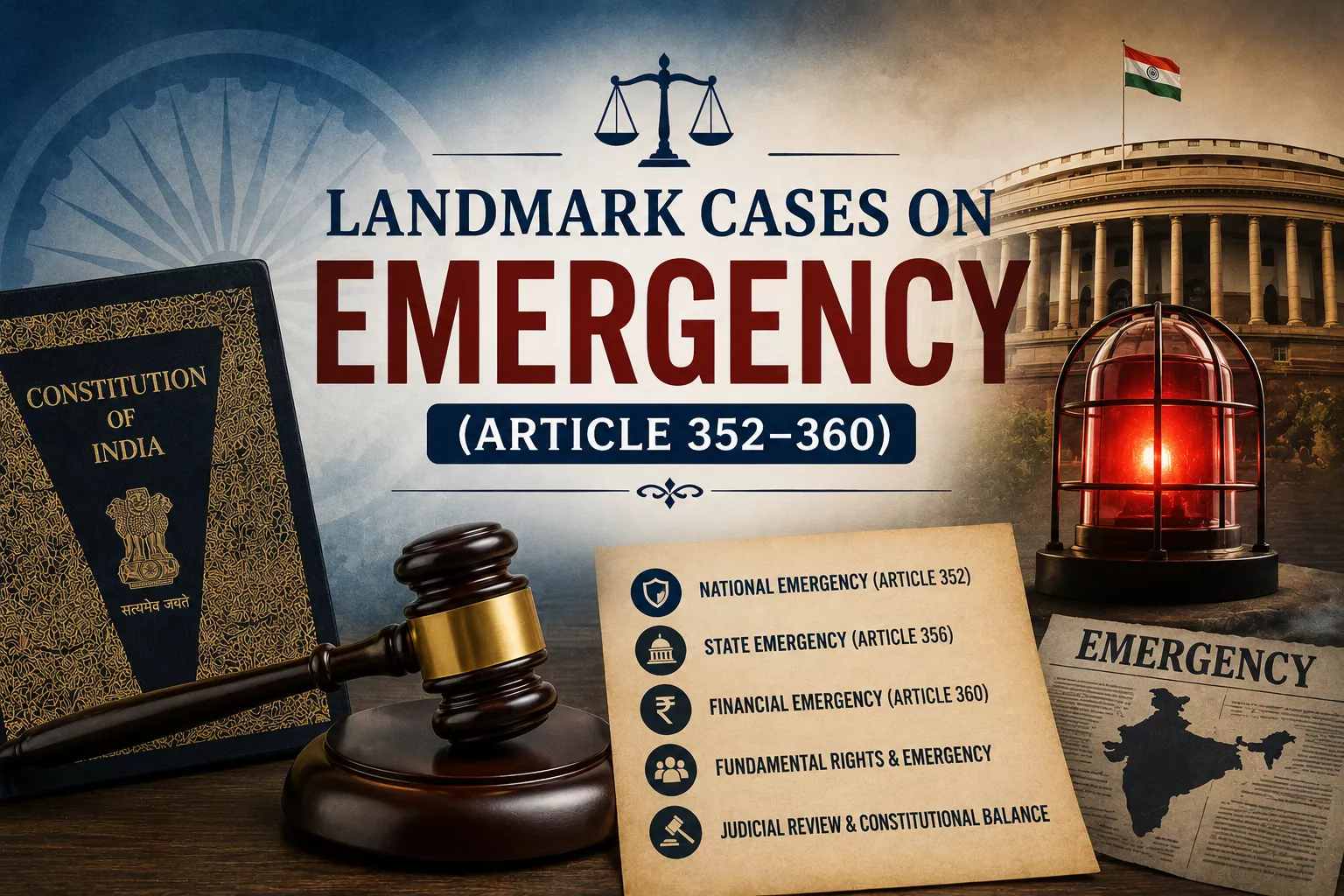
The following landmark judgments explain the constitutional provisions relating to Emergency under the Constitution of India. These decisions deal with the suspension of Fundamental Rights, judicial review of Proclamation of Emergency, President's Rule under Article 356, and the constitutional limitations on the exercise of emergency powers.
1. A.D.M., Jabalpur v. Shivkant Shukla (AIR 1976 SC 1207)
Held: Supreme Court held that during the proclamation of emergency rights under Article 21 can also be suspended and no person shall have any locus standi for enforcement of such right. This case is also known as habeas corpus case.
2. Minerva Mills Ltd. v. Union of India (AIR 1980 SC 1789)
Held: Supreme Court held that there is no bar to judicial review of the validity of proclamation of emergency. However, the court's power is limited to examining whether the limitations conferred by the Constitution have been observed or not. If the satisfaction of the President is absurd, mala fide or perverse then it would be liable to be challenged in the court of law.
3. Minerva Mills Ltd. v. Union of India (AIR 1980 SC 1789)
Held: It was held that There is no bar to judicial review of the validity of a proclamation of emergency issued by the President under Article 352. The court's power is limited to only examining whether the limitations conferred by the Constitution have been observed or not. Where the satisfaction is absurd, perverse, mala fide or based on wholly irrelevant considerations, it would be no satisfaction at all and it would be liable to be challenged before a court of law.
4. Rameshwar Prasad v. Union of India (2006) 2 SCC 1)
Held: Supreme Court held that the Governor while recommending dissolution of Assembly has to annex with the report relevant materials substantiating his decision. In absence of relevant materials it will be considered as a personal opinion of the Governor.
5. S.R. Bommai v. Union of India (1994) 3 SCC 1)
Held: Supreme Court held that judicial review of Presidential proclamation is permissible if the allegations of mala fides have been levelled in the petition.
The Court laid down the following guidelines:-
- Proclamation dissolving State Legislative Assembly is subject to judicial review;
- President's rule cannot be imposed on the ground of political considerations;
- Imposition of President's rule and dissolution of State Assembly cannot be done together;
- State Assembly can only be dissolved after Parliament approves the proclamation.
- Existence of materials is a pre-condition to form the basis of satisfaction for imposition of President's rule.
6. Shree Meenakshi Mills Ltd. v. Union of India (AIR 1974 SC 366)
Held: It was held that During a proclamation of emergency, Article 358 does not apply to executive actions that are a continuation of prior actions or arise from an existing law that violates Article 19 or is otherwise unconstitutional.
7. Union of India v. Pesticides Manufacturing and Formulators Association of India (AIR 2003 SC 87)
Held: It was held that The process of scheduling elections for a new Legislative Assembly must begin immediately after the Assembly is dissolved. The provisions of Article 356, which deal with the imposition of emergency in a State, have no bearing on determining the election schedule.