Table of Contents
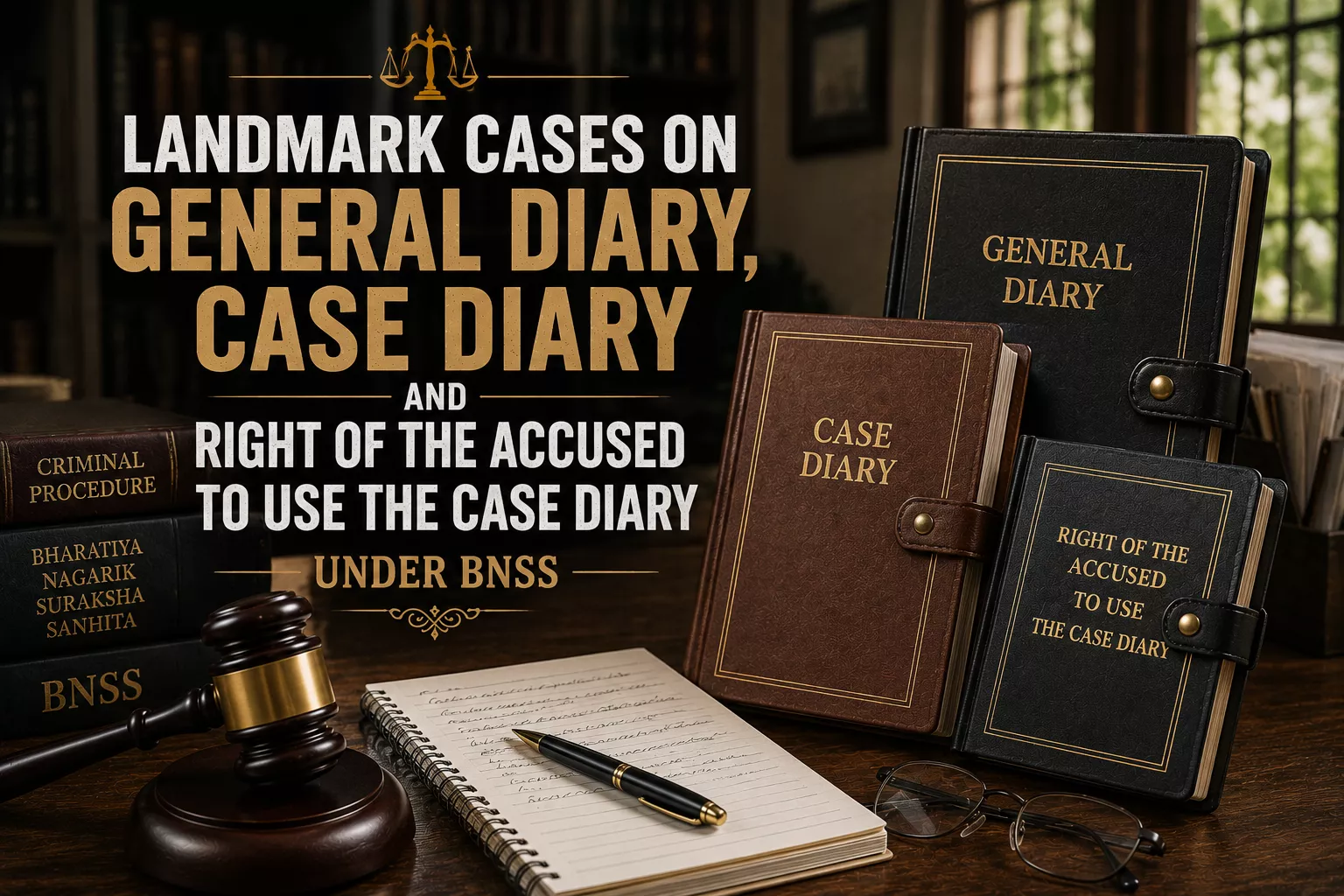
The following landmark judgments explain the legal principles relating to the General Diary, Case Diary, and the accused's right to use the Case Diary under the Code of Criminal Procedure (now the Bharatiya Nagarik Suraksha Sanhita, 2023). These decisions clarify the evidentiary value of diary entries, the scope of cross-examination using the case diary, and the limited rights available to the accused in relation to police diaries.
1. Balakram v. State of Uttarakhand (2017) 7 SCC 668)
Held: It was held that Right of accused to cross examine police officer with reference to the entries in the police diary is very much limited in extent and even that limited scope rises only when the police officer uses it for refreshing his memory and it is subject to provisions of Section 145 and 161 of Indian Evidence Act (now Section 148 and Section 164 of BSA). There is no scope in Section 172 (now Section 192 of BNSS) to enable the court, prosecution or accused to use police diary for purpose of contradicting any witness other than police officer. The court has unfettered power to call for and examine the entries in the police diaries maintained by the investigating officer.
2. Shailesh Kumar v. State of U.P. (now State of Uttarakhand) (2024 INSC 143)
Held: Supreme Court held that Section 172(3) of Cr.P.C. (now Section 192(5) of BNSS) makes a specific reference to Section 145 and Section 161 of the Evidence Act (now Section 148 and Section 164 of BSA). Therefore, whenever a case is made out either under Section 145 or under Section 161 of the Evidence Act (now Section 148 and Section 164 of BSA) the benefit thereunder along with the benefit of Section 172(3) of Cr.P.C. (now Section 192(5) of BNSS) has to be extended to an accused. Thus, the accused has a right to cross-examine a police officer as to the recording made in the case diary whenever the police officer uses it to refresh his memory. Similarly, in a case where the court uses a case diary for the purpose of contradicting a police officer, then an accused is entitled to peruse the said statement so recorded which is relevant, and cross-examine the police officer on that count. Thus, Section 145 and Section 161 of the Evidence Act (now Section 148 and Section 164 of BSA) on the one hand and Section 172(3) of Cr.P.C. (now Section 192(5) of BNSS) on the other are to be read in consonance with each other, subject to the limited right conferred under Section 172(3) of Cr.P.C. (now Section 192(5) of BNSS).
3. State v. H. Srinivas (2018) 7 SCC 572)
Held: It was held that The obligation of maintenance of the General Diary is a part of the course of conduct of the officer concerned. Non-maintenance of General Diary may not itself have any bearing on the criminal trial unless some grave prejudice going to the root of the matter is shown.