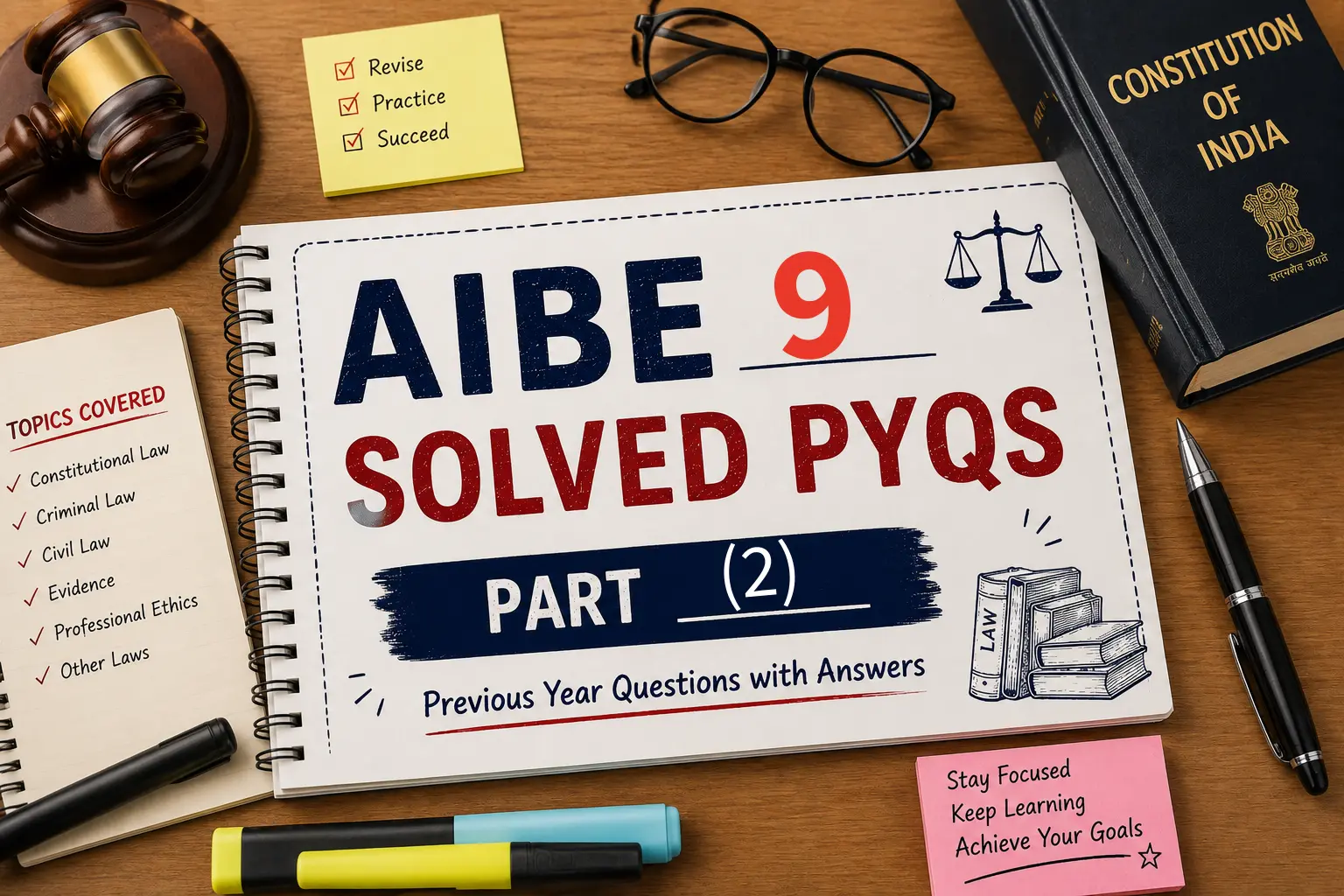
Practice the AIBE 9 (2016) Part 2 Solved Question Paper with all 100 original multiple-choice questions and official answer key-based solutions. An excellent resource for AIBE preparation and revision.
Access Part 1 :- AIBE 9 (2016) Solved
Q51. A retracted confession:
(A) can be solely made the basis of conviction
(B) cannot be solely made the basis of conviction
(C) cannot be solely made the basis of conviction unless the same is corroborated
(D) both (A) and (C) are correct
Answer: C
Q52. A confession to be inadmissible under Section 25 of the Act:
(A) must relate to the same crime for which offender is charged
(B) may relate to the same crime for which offender is charged
(C) must relate to another crime
(D) none of the above
Answer: C
Q53. An unjustified and unexplained long delay on the part of the investigating officer in recording the statement of a material witness would render the evidence of such witness:
(A) Unreliable
(B) Inadmissible
(C) Inadmissible and unreliable
(D) None of the above
Answer: A
Q54. Recording of pre-summoning evidence may be dispersed with under Section 200 of CrPC:
(A) If the complaint is supported by the affidavit of the complainant
(B) If the complaint is made in writing by a public servant in the discharge of his official duties
(C) both (A) and (B) are correct
(D) only (A) is correct but (B) is incorrect
Answer: B
Q55. Contract without consideration made in writing and registered and made on account of natural love and affection is:
(A) Void
(B) Reasonable
(C) Valid
(D) Unenforceable
Answer: C
Q56. Under the Transfer of Property Act, 1882:
(A) the salary of a public officer can be transferred
(B) the salary of a public officer cannot be transferred
(C) public office can be transferred
(D) none of the above
Answer: B
Q57. Where a debt is transferred for the purpose of securing an existing or future debt, the debt so transferred, if received by the transferor or recovered by the transferee is applicable first in payment of cost of such recovery. This is the provision of:
(A) mortgaged debt
(B) gift
(C) actionable claim
(D) lease
Answer: A
Q58. A suit under Section 6 of the Specific Relief Act can be brought by:
(A) Trespasser
(B) a tenant holding over
(C) servant
(D) manager
Answer: B
Q59. Injunction cannot be granted in a suit:
(A) in which the specific performance cannot enforced
(B) for breach of negative contract to enforce specific contract
(C) for declaration where the plaintiff is in possession
(D) neither (A), nor (B), nor (C)
Answer: A
Q60. State practice for the formation of customary rule includes:
- State actions
- State claims
(A) only 1
(B) only 2
(C) both 1 and 2
(D) neither 1 nor 2
Answer: C
Q61. The Controller of Certifying Authorities in India must maintain a database of the disclosure records of:
- Certifying Authority
- Cross Certifying Authority
- Foreign Certifying Authority
(A) 1 and 2
(B) 2 and 3
(C) 3 and 1
(D) 1, 2 and 3
Answer: A
Q62. Under Section 37 of the IT Act, 2000, the certifying authority can suspend the digital signature certificate if:
- The subscriber is found guilty of malpractice
- The subscriber is involved in cyber terrorism
- The subscriber requests for the same
- In public interest
(A) 1 and 2
(B) 2 and 3
(C) 3 and 4
(D) 4 and 1
Answer: C
Q63. In the cases before Cyber Appellate Tribunal, the appellant:
(A) Cannot appear in person without a legal practitioner
(B) Cannot authorize a legal practitioner to appear on his behalf
(C) Cannot authorize his officer to appear on his behalf
(D) Cannot authorize his relative who is neither his officer nor a legal practitioner to appear on his behalf
Answer: D
Q64. In the light of the Criminal Law Amendment Act, 2013, which of the following statements is/are correct:
(A) The word "rape" in Section 375 of Indian Penal Code, 1860 has been replaced with sexual assault
(B) Rape is now a gender neutral offence
(C) The amendment has fixed the age for consensual sex as 16 years
(D) All the above
Answer: * (As per the uploaded answer sheet)
Q65. The offence of stalking upon second or subsequent conviction is:
(A) Non cognizable and Bailable
(B) Cognizable and Bailable
(C) Cognizable and Non-bailable
(D) Non cognizable and Non-bailable
Answer: C
Q66. In kidnapping the consent of minor is:
(A) wholly immaterial
(B) partly immaterial
(C) wholly material
(D) partly material
Answer: A
Q67. Under the provisions of the Trade Unions Act, 1926, any person who has attained the age of......may be a member of a registered Trade Union subject to any rules of the Trade Union to the contrary.
(A) 14 years
(B) 15 years
(C) 18 years
(D) 21 years
Answer: B
Q68. Spurious goods under the provisions of the Consumer Protection Act, 1986 imply:
(A) Such goods and services which are of poor quality
(B) Such goods and services which are claimed to be genuine but they are actually not so
(C) Such goods and services which might be stolen in nature
(D) Such goods and services which are not usable in nature
Answer: B
Q69. Who is liable to pay compensation in case of death or permanent disablement?
(A) Owner of the vehicle
(B) State Government
(C) Driver
(D) Insurance Company
Answer: A
Q70. Indian Evidence Act applies to:
(A) Proceedings before tribunals
(B) Proceedings before the arbitrator
(C) Judicial proceedings in Court
(D) All of the above
Answer: C
Q71. Fact in issue means:
(A) Fact, existence or non-existence of which is admitted by the parties
(B) Fact, existence or non-existence of which is disputed by the parties
(C) Fact, existence or non-existence of which is not disputed by the parties
(D) All the above
Answer: B
Q72. In a bailable offence bail is granted as a matter of right:
(A) By the police officer
(B) By the court
(C) Both by the police officer and the court
(D) either (A) or (B)
Answer: C
Q73. A proclaimed person whose property has been attached can claim the property or the sale proceeds on appearance:
(A) within 6 months of attachment
(B) within 2 years of attachment
(C) within 3 years of attachment
(D) within 1 year of attachment
Answer: B
Q74. The question whether a statement was recorded in the course of investigation is a:
(A) question of law
(B) question of fact
(C) mixed question of law and fact
(D) question of law or of fact depends on facts and circumstances
Answer: B
Q75. Where the police submits a final report under Section 173(2) of CrPC for dropping of proceedings to a magistrate, the Magistrate:
(A) may accept the same.
(B) may reject the same.
(C) may reject the same and order further investigation.
(D) any of the above.
Answer: D
Q76. The orders under Section 125 of CrPC are:
(A) summary in nature but finally determine the rights and obligations of the parties
(B) summary in nature and do not finally determine the rights and obligations of the parties which are to be finally determined by a Civil Court
(C) Substantive in nature and finally determine the obligations of the parties
(D) Substantive in nature and are not subject to determination of a right of the parties by a Civil Court
Answer: B
Q77. A contingent contract based on the specified uncertain events not happening within a fixed time under Section 35:
(A) remains valid even if the event does not happen within that fixed time
(B) becomes void at the expiration of the time fixed
(C) becomes void if the happening of that event becomes impossible before the expiry of the time fixed
(D) both (B) and (C)
Answer: D
Q78. Which among the following is authorized under the Information Technology Act, 2000 to prescribe the security procedures and practices for the purpose of Sections 14 and 15 of the Act?
(A) Central Government
(B) State Government
(C) Certifying authority
(D) Issuing authority
Answer: A
Q79. The essential ingredient of the tort of negligence are:
- When one owes a duty of care towards the other
- When one commits a breach of that duty and
- The other person suffers damage as a consequence thereof
Choose correct response from below:
(A) None of them are essential ingredients
(B) Only the first is an essential ingredient
(C) All of them are essential ingredients
(D) Even if the first is absent the tort of negligence is committed
Answer: C
Q80. Vicarious liability includes:
(A) Liability of the principal for the tort of his agent
(B) Liability of the master for the tort of his servant
(C) Liability of the partners, for each others tort
(D) all of the above
Answer: D
Q81. Necessity rule as to admissibility of evidence is applicable when the maker of a statement:
(A) is dead or has become incapable of giving evidence
(B) is a person who can be found but his attendance cannot be procured without unreasonable delay or expenses
(C) is a person who cannot be found
(D) all of the above
Answer: D
Q82. Secondary evidence of a document means:
(A) Copies of the document
(B) oral account of the contents of the documents
(C) both (A) and (B)
(D) none of the above
Answer: C
Q83. A Will is required to be proved by calling at least one attesting witness:
(A) when it is registered
(B) when it is unregistered
(C) when it is admitted
(D) All of the above
Answer: D
Q84. Any person in Section 106 of Indian Evidence Act refers to:
(A) a party to the suit
(B) a stranger to the suit
(C) a person who is not a party to the suit but interested in the outcome of the suit
(D) all of the above
Answer: A
Q85. In a cognizable case under IPC, police have the:
(A) Authority to arrest a person without warrant
(B) Authority to investigate the offence without permission of the Magistrate
(C) Both (A) and (B)
(D) Either (A) and (B)
Answer: C
Q86. During investigation a search can be conducted without warrant by:
(A) any police officer
(B) by the investigating officer
(C) both (A) and (B)
(D) either (A) or (B)
Answer: C
Q87. Committal proceedings under Section 209 of CrPC are in the nature of:
(A) aid in investigation
(B) inquiry
(C) trial
(D) either inquiry or trial
Answer: B
Q88. Which is correct:
(A) proposal + acceptance = promise
(B) promise + consideration = agreement
(C) agreement + enforceability = contract
(D) all of the above
Answer: D
Q89. Communication of acceptance is complete as against the proposer:
(A) when it comes to the knowledge of the proposer
(B) when it is put in course of transmission to him so as to be out of power of the acceptor
(C) when the acceptance is communicated to the proposer
(D) all of the above
Answer: B
Q90. In cases of general offer, for a valid contract:
(A) the acceptor need not have the knowledge of the offer
(B) the acceptor must have the knowledge of the offer before acceptance by performance
(C) the acceptor may acquire the knowledge of the offer after the performance as the condition for acceptance
(D) knowledge does not matter so long as the condition is performed with or without knowledge
Answer: B
Q91. Under the provision of the Transfer of Property Act, 1882, the unborn person acquires vested interest on transfer for his benefit:
(A) upon his birth
(B) 7 days after his birth
(C) 12 days after his birth
(D) no such provision is made
Answer: A
Q92. Every transfer of immovable property made with intent to defeat or delay the creditors of the transferor shall be voidable:
(A) at the option of creditor so defeated or delayed
(B) at the option of debtor
(C) at the option of court
(D) none of the above
Answer: A
Q93. Where co-judgment debtors are in the position of joint promisors, each is:
(A) not jointly and severally liable to the decree holder
(B) jointly and severally liable to the decree holder
(C) jointly liable to the decree holder only
(D) severally liable to the decree holder only
Answer: B
Q94. At sight under Section 21 of the Negotiable Instruments Act, 1881 means:
(A) on presentation
(B) on demand
(C) on coming into vision
(D) none of the above
Answer: B
Q95. Section 5 of the Limitation Act applies to:
(A) Suits
(B) Execution
(C) Election petitions
(D) None of the above
Answer: D
Q96. Which of the following Companies will have to constitute Corporate Social Responsibility Committee under the Companies Act, 2013:
(A) A Company having net profit of 2.5 crores in a financial year, a net worth of 300 crores and turnover of rupees 800 crore
(B) A Company having a net profit of 3 crores, in a financial year a net worth of 300 crores and a turnover of rupees 600 crore
(C) A Company having a net profit of 5 crores or more, a net worth of 500 crores and a turnover of rupees 1000 crore or more
(D) A Company having a net profit of 5 crores or more, a net worth of 500 crores and a turnover of rupees 5000 crore or more
Answer: C
Q97. A Disqualified person/heir:
(A) Transmits an interest to his or her own heir
(B) Transmits no interest to his or her own heir
(C) May or may not transmit an interest to his or her own heir as per the discretion of the court
(D) May only transmit an interest to his or her own heir with the consent of the other heirs
Answer: B
Q98. In cases in which a specific act confers a discretionary power on an authority:
(A) The court can direct the manner in which the power is exercised
(B) The court can direct that the power be exercised in accordance with law
(C) Both (A) and (B)
(D) Neither (A) nor (B)
Answer: C
Q99. The Bar Council of India Rule which stipulated that persons aged 45 years and above could not be enrolled as advocates was struck down by the Supreme Court in:
(A) In E.S. Reddy v. Bar Council of India
(B) Indian Council of Legal Aid and Advice v. Bar Council of India
(C) P. Shanmugam v. Bar Council of India
(D) Legal Committee v. Bar Council of India
Answer: B
Q100. Which is an incorrect statement:
(A) An Arbitral award is a contract
(B) An Arbitral award must be in writing and signed
(C) An Arbitral award included an interim award
(D) None of the above
Answer: A