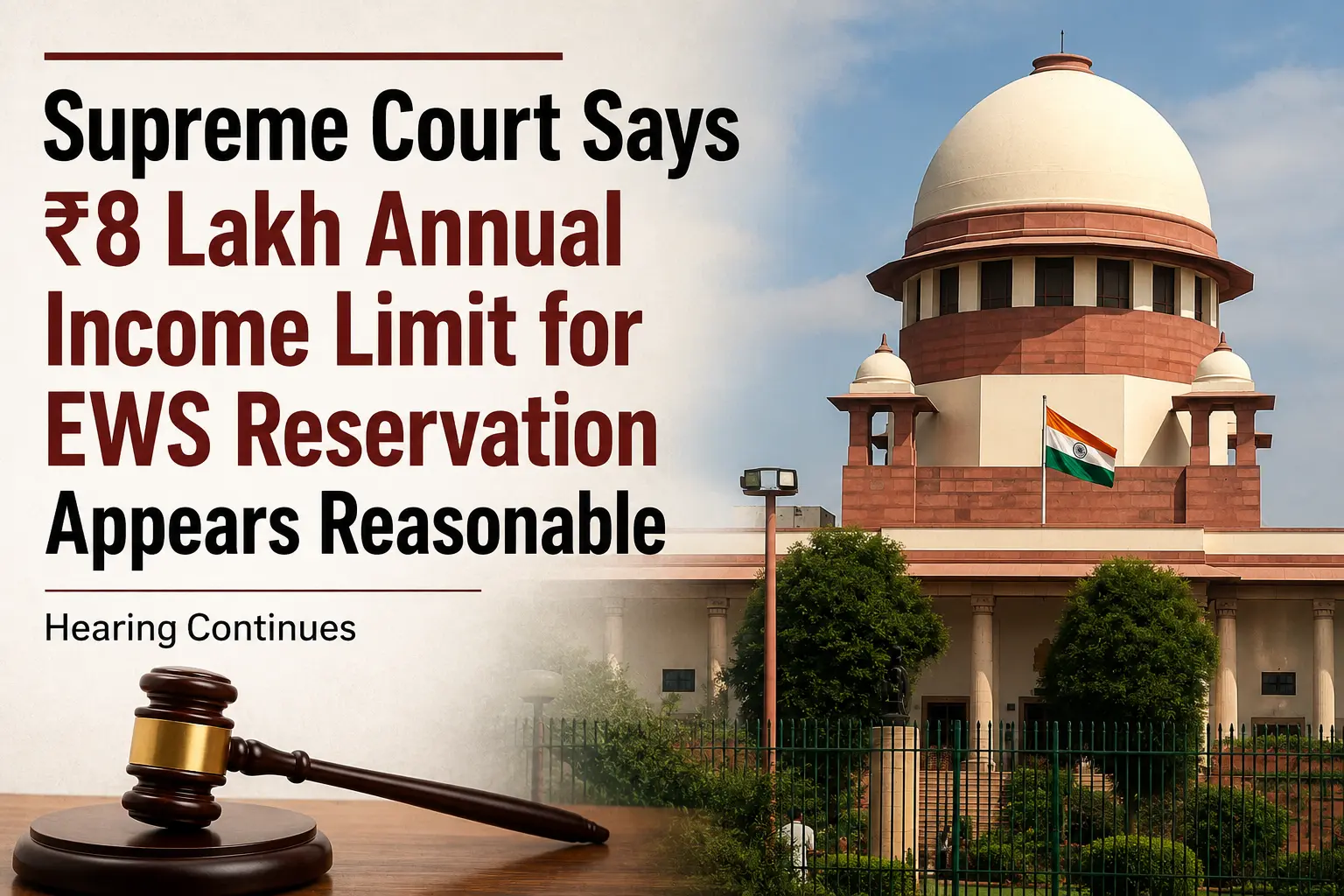
The Supreme Court on Wednesday observed that the ₹8 lakh annual family income limit for determining eligibility under the Economically Weaker Sections (EWS) reservation appears to be prima facie reasonable. However, the Court made it clear that this is only a preliminary view and that the issue will be examined in detail before any final decision is taken.
A Bench hearing petitions related to the 10% EWS reservation considered arguments challenging both the income limit and the overall eligibility criteria. During the hearing, the Bench pointed out that the income ceiling cannot be looked at in isolation because EWS eligibility is also determined by factors such as ownership of residential property, agricultural land, plots, and other assets.
The Court observed that, on the face of it, fixing the annual income limit at ₹8 lakh does not appear to be arbitrary or unreasonable. At the same time, it stressed that this should not be treated as its final opinion. The Bench said it would thoroughly examine every aspect of the policy before delivering its verdict.
The petitions before the Court question whether the existing EWS eligibility norms truly identify economically weaker families. The petitioners have argued that the ₹8 lakh income threshold is too high and may allow families that are not genuinely economically disadvantaged to avail the benefits of the reservation.
Reiterating that the matter is still under consideration, the Supreme Court clarified that it has not reached any final conclusion on the validity or appropriateness of the income criterion. The hearing will continue, and the Court will examine the constitutional and policy issues involved before pronouncing its final judgment.
The case is significant because it relates to the implementation of the 10% reservation for Economically Weaker Sections, introduced through the 103rd Constitutional Amendment. The amendment provides reservation in admissions to educational institutions and public employment for eligible candidates from economically weaker sections who do not fall under the existing reserved categories.
This version is more conversational and reads like a professionally written legal news article while preserving the original meaning and factual content.