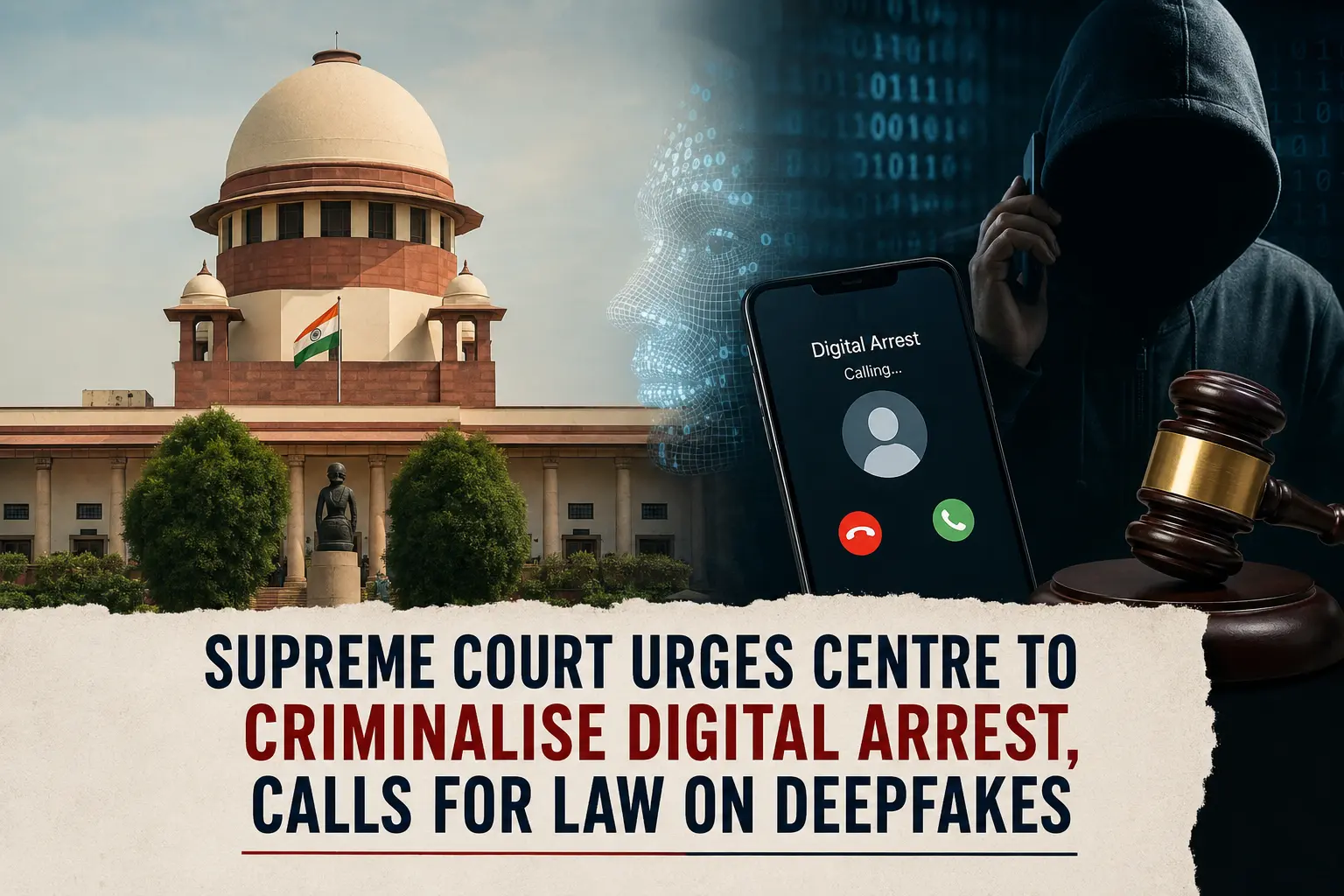
The Supreme Court on Tuesday urged the Central Government to enact a separate law that would make "digital arrest" a distinct criminal offence and introduce a comprehensive legal framework to tackle the growing misuse of deepfake technology. The Court observed that the existing legal provisions are not sufficient to effectively address these emerging forms of cybercrime.
A Bench comprising Chief Justice of India Justice Surya Kant, Justice Joymalya Bagchi, and Justice V. Mohan was hearing the suo motu proceedings initiated to strengthen measures against digital arrest scams and other cyber frauds.
During the hearing, the Bench observed that digital arrest scams have become a serious concern across the country and require a dedicated legal framework. It suggested that the offence should be specifically recognised under criminal law and attract stricter punishment to discourage offenders. The Court also highlighted the urgent need for robust legislation to deal with deepfakes, noting that the technology is increasingly being misused for fraud, impersonation, and spreading misinformation.
Representing the Union Government, Solicitor General Tushar Mehta informed the Bench that the Centre is already preparing a draft law to address digital arrests, deepfakes, and other technology-driven crimes. He assured the Court that the proposed legislation aims to comprehensively tackle these emerging challenges.
The observations were made during the hearing of the Supreme Court's suo motu case concerning the increasing number of digital arrest scams, in which fraudsters impersonate police officers or government officials to threaten victims into transferring money or revealing sensitive financial information.
The Supreme Court has repeatedly expressed concern over the rapid rise in such cyber frauds and has stressed the need for coordinated efforts by the government and investigating agencies. Observing that criminals are increasingly exploiting artificial intelligence and other advanced digital technologies, the Bench said the legal framework must evolve with changing technology to provide stronger protection to citizens.

.webp)