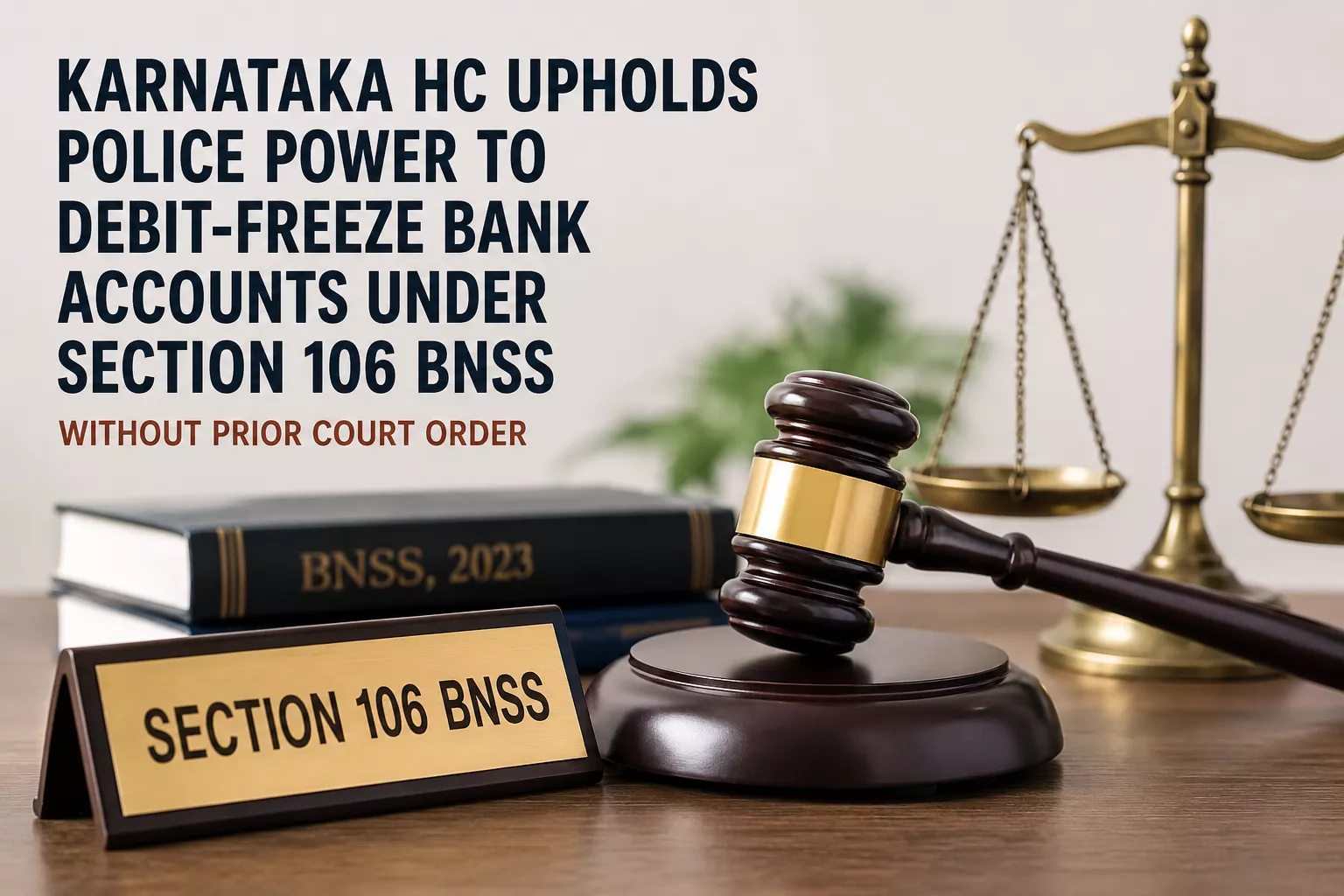
The Karnataka High Court has ruled that police can debit-freeze a bank account during a criminal investigation under Section 106 of the Bharatiya Nagarik Suraksha Sanhita (BNSS), 2023, without obtaining a prior court order.
The ruling came in a matter involving JAR Gold Retail Private Limited, where the police had frozen the company's bank accounts during an investigation into alleged violations of the Banning of Unregulated Deposit Schemes Act, 2019.
The company challenged the freezing of its accounts, arguing that police could not attach or freeze bank accounts under Section 106 BNSS without following the procedure under Section 107 BNSS, which involves judicial oversight.
The High Court, however, distinguished between the two provisions. It held that Section 106 gives investigating officers the power to seize or secure property during an investigation, while Section 107 deals with the formal attachment of property and requires the involvement of the court.
The Court therefore held that police do not have to obtain prior judicial permission before taking immediate action to prevent suspected funds from being transferred or withdrawn.
At the same time, the Court clarified that the police must report the seizure to the jurisdictional Magistrate as required under Section 106 BNSS. The power to freeze an account during investigation does not mean that police can permanently attach or forfeit the funds without following the applicable judicial procedure.
The decision is particularly significant in financial fraud and cybercrime cases, where money can be transferred quickly and immediate action may be necessary to preserve suspected proceeds of crime.
The judgment provides important clarity on the distinction between freezing or securing property during investigation under Section 106 BNSS and formal attachment proceedings under Section 107 BNSS.