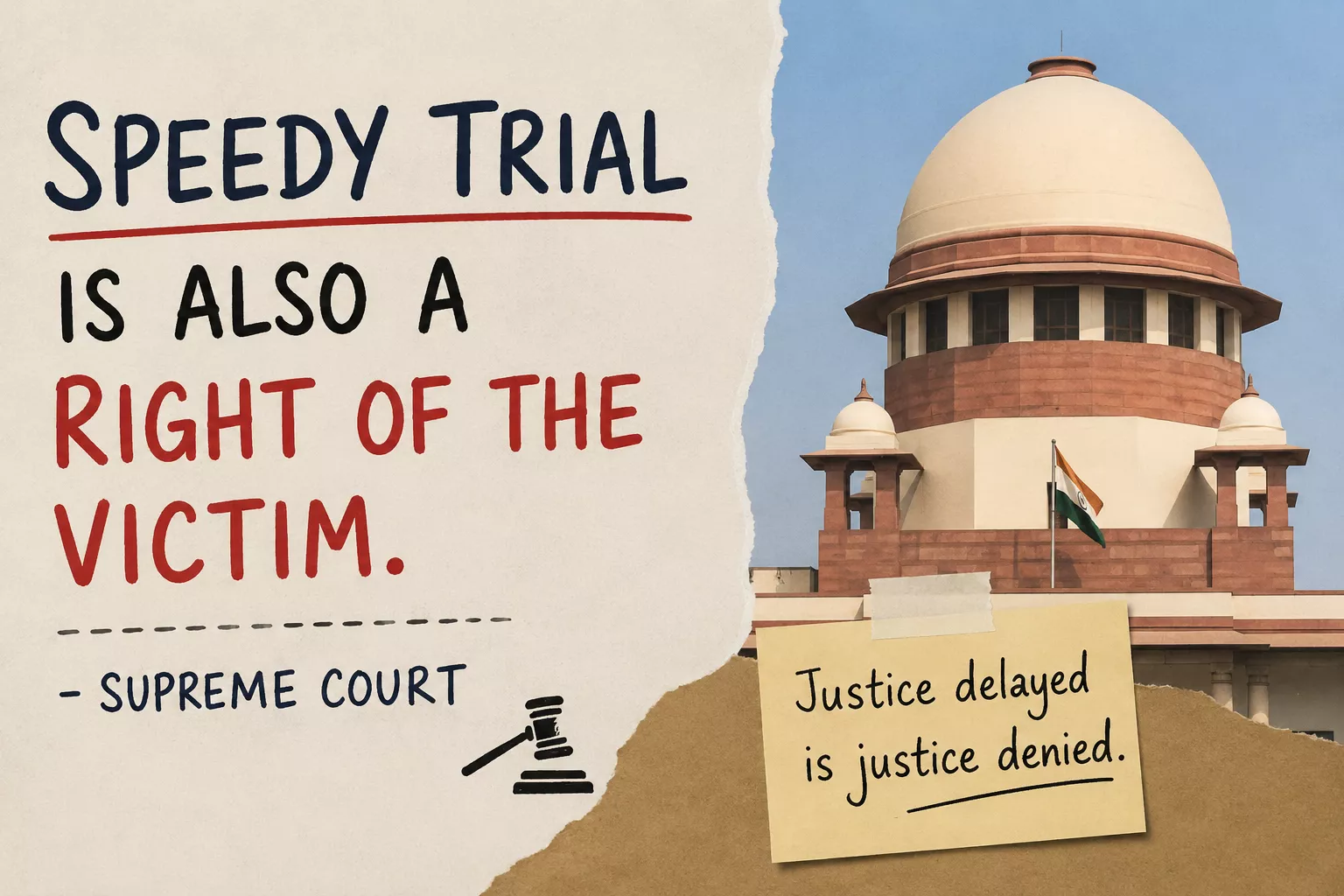
The Supreme Court has held that the right to a speedy trial under Article 21 of the Constitution is not limited to an accused person and is equally an important right of the victim. The Court observed that an unreasonable delay in criminal proceedings can have a harmful impact not only on the parties involved but also on society as a whole. The judgment underlines the importance of ensuring that criminal cases are taken to their logical conclusion without unnecessary delay.
A bench comprising Justices K. V. Viswanathan and Arun Palli made the observations while setting aside an order of the Allahabad High Court concerning the priority of trials under the Uttar Pradesh Gangsters and Anti-Social Activities (Prevention) Act. The High Court had held that where a person was facing prosecution under both the Bharatiya Nagarik Suraksha Sanhita (BNSS) and the Gangsters Act, proceedings under the Gangsters Act would take precedence and the trial in the other case would remain in abeyance.
The Supreme Court examined Section 12 of the Gangsters Act, which provides that proceedings under the Act shall have precedence over any other case against the accused. According to the bench, the provision does not mean that the trial of another criminal case must be indefinitely kept on hold. Instead, it indicates that where there is a clash between hearing dates, proceedings under the Gangsters Act should receive preference.
The Court stressed that the constitutional guarantee of a speedy trial must also take into account the interests of victims. Prolonged proceedings can cause serious prejudice because evidence may become difficult to preserve as time passes. Witnesses may become unavailable, memories can fade and relevant material may become harder to secure, potentially affecting the proper administration of justice.
The bench cautioned that every day's delay can create difficulties in preserving evidence and may ultimately result in serious injustice. It therefore emphasized that speedy disposal of criminal cases is not merely a safeguard for the accused but also an important component of justice for victims and society. The Supreme Court's observation reinforces the broader principle that criminal proceedings must be conducted fairly and efficiently, without allowing procedural priorities to result in unnecessary or indefinite delays.