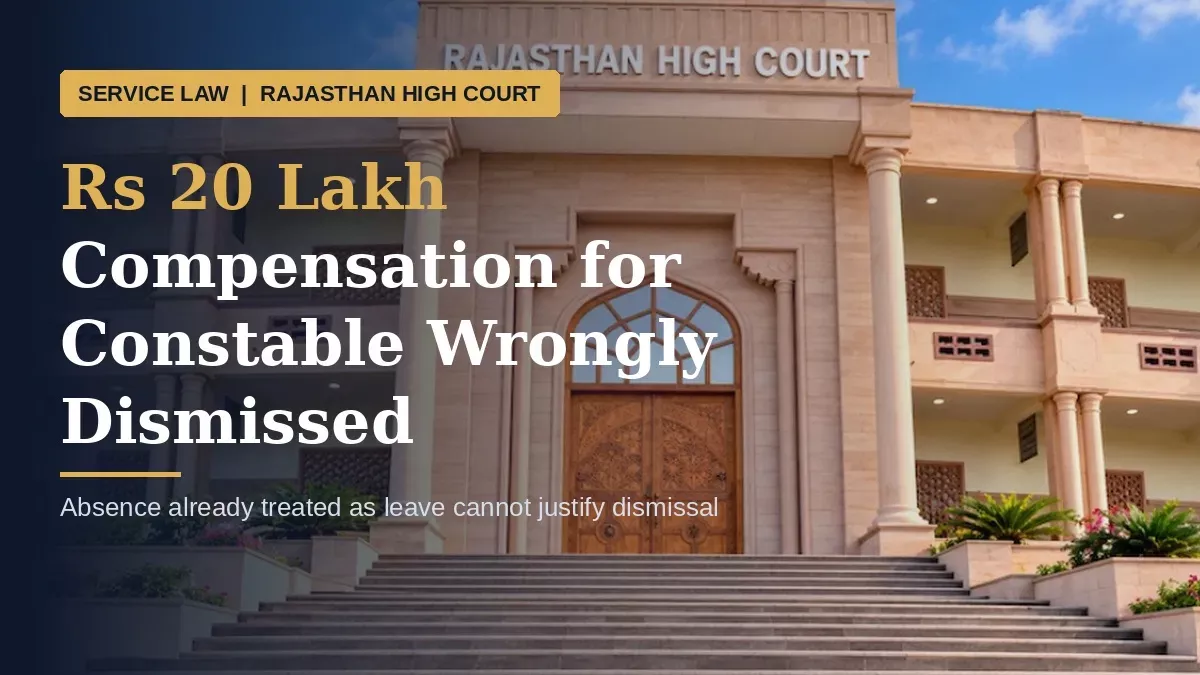
The Rajasthan High Court has held that a police constable cannot be dismissed for unauthorised absence when the same order has already treated that absence as leave. Rather than reinstating the constable, who has been out of service for more than 28 years, the court directed the State to pay him Rs 20 lakh as lump-sum compensation.
How the Case Began
Shaitana Ram joined the Rajasthan Police as a constable on November 9, 1990. On February 19, 1996, while posted at Nagaur, he left for his native village without permission or sanctioned leave. On March 1, 1996, an FIR was registered naming him in the murder of his brother, Basti Ram, and he was arrested on April 15, 1996. He remained in police and judicial custody until the trial court acquitted him, giving him the benefit of doubt.
Meanwhile, the department held an inquiry on five charges, including the absence and the murder case, and dismissed him on January 7, 1998. His departmental appeal and revision before the Governor failed, and a Single Judge dismissed his writ petition in 2008.
Why the Dismissal Failed
In the special appeal, a Division Bench of Justice Vinit Kumar Mathur and Justice Sandeep Shah found the dismissal order contradictory. It held that the period after his arrest could not be unauthorised absence because he was in custody. It treated only the 56 days between February 19 and April 15, 1996 as unauthorised, and then regularised even those days as leave without pay.
The bench said an authority cannot excuse an absence and punish it in the same order, as that amounts to taking two inconsistent positions. Relying on State of Punjab v. Dr P.S. Singla, it held that once absence is regularised, it can no longer be treated as misconduct. The court accepted that this point had not been pressed earlier, when only the quantum of punishment was challenged, but still held the dismissal could not stand. It also noted that no clear finding had been recorded on the murder allegation despite the acquittal, and that not every absence without permission is wilful.
Compensation Instead of Reinstatement
The court declined reinstatement. It noted that he had served only five years, that his past record was marked as unsatisfactory, and that reinstating him after 28 years would not suit the discipline required in police service. Citing Maharashtra State Road Transport Corporation v. Mahadeo Krishna Naik, it observed that lump-sum compensation can be a better remedy in suitable cases.
The State must pay Rs 20 lakh within three months of receiving a certified copy of the judgment, failing which 6 per cent annual interest will apply. He is not entitled to reinstatement or any other service benefits.
Case: Shaitana Ram v. State of Rajasthan & Others, D.B. Special Appeal Writ No. 1133/2011.