Table of Contents
- 1. Begum Sabano v. A.M. Abdul Gafoor (1987) 2 SCC 285)
- 2. Bhagwan Dutt v. Kamala Devi (1975) 2 SCC 386)
- 3. Chaturbhuj v. Sita Bai (2008) 2 SCC 316)
- 4. D. Velusamy v. D. Patchaiammal (2010) 10 SCC 469)
- 5. Dr. Swapan Kumar Banerjee v. State of West Bengal and Anr. (2019) 19 SCC 342)
- 6. Kamala v. M.R. Mohan Kumar (2019) 11 SCC 491)
- 7. Mohd. Ahmed Khan v. Shah Bano Begum (AIR 1985 SC 945)
- 8. Nanak Chandra v. Chandra Kishore (1969) 3 SCC 802)
- 9. Reema Salkan v. Sumer Singh Salkan (2019) 12 SCC 303)
- 10. Sanjeev Kapoor v. Chandana Kapoor (2020) 13 SCC 172)
- 11. Savitaben v. State of Gujarat (AIR 2005 SC 1089)
- 12. Sunita Kachwaha v. Anil Kachwaha (2014) 16 SCC 715)
- 13. V.D. Bhanot v. Savita Bhanot (2012) 3 SCC 183)
- 14. Vijay Manohar v. Kashi Rao Raja Ram (AIR 1987 SC 1100)
- 15. Yamunabai v. Anantrao (AIR 1988 SC 644)
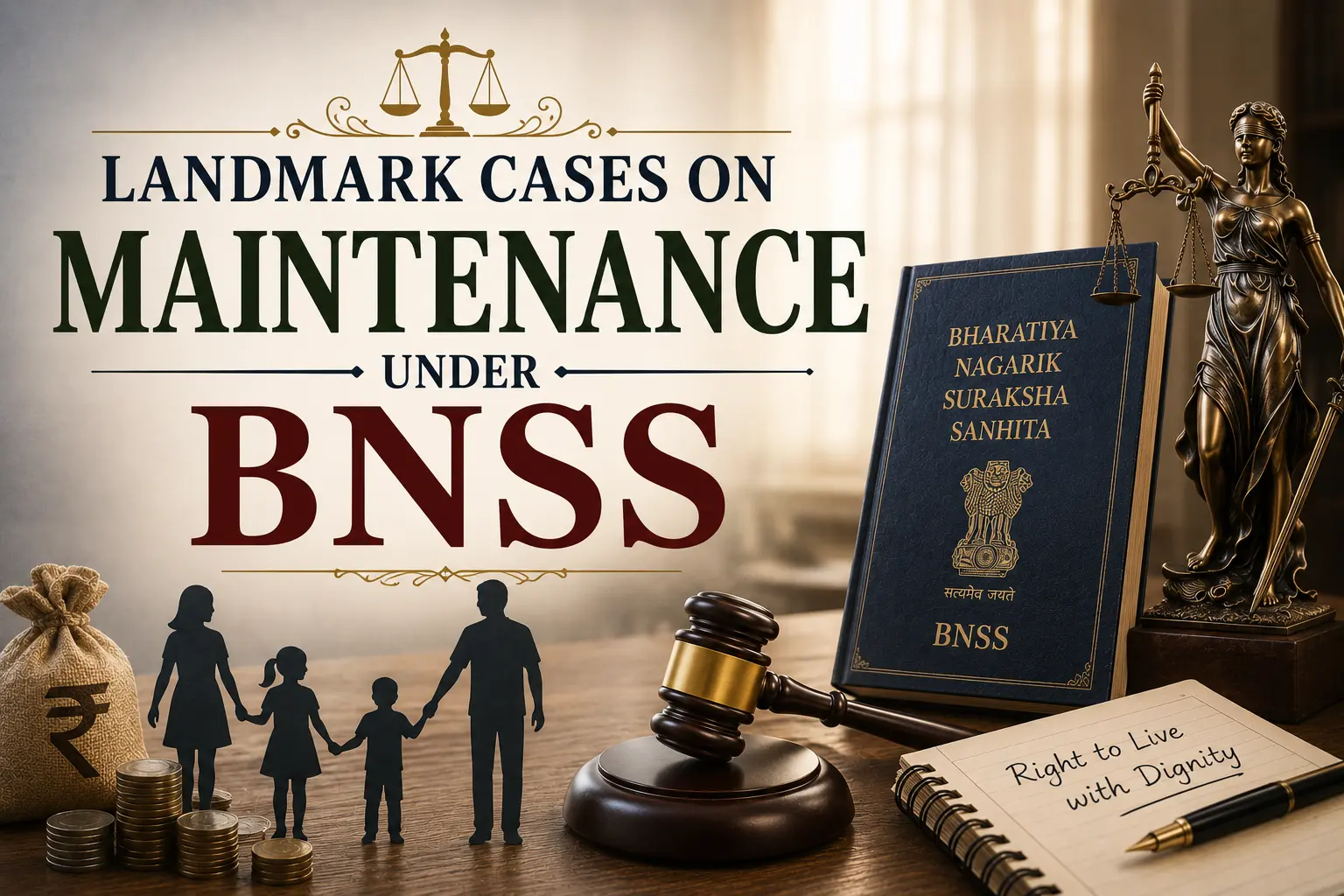
The following landmark judgments explain the principles governing maintenance under the Code of Criminal Procedure (now Section 144 of the Bharatiya Nagarik Suraksha Sanhita, 2023). These cases deal with the right to maintenance of wives, divorced women, women in live-in relationships, daughters, and the scope and object of the maintenance provisions.
1. Begum Sabano v. A.M. Abdul Gafoor (1987) 2 SCC 285)
Held: In this case Bigamy is allowed under Muslim law and husband is not criminally liable for contracting second marriage. However, a Muslim wife would surely be entitled to live separately and claim maintenance solely on the ground that second marriage of her husband has caused her mental agony and cruelty. In such a situation, husband cannot take shelter of his personal law and claim immunity from Section 125 (now Section 144 of BNSS).
2. Bhagwan Dutt v. Kamala Devi (1975) 2 SCC 386)
Held: Supreme Court laid down following objectives of Section 125 of the Code (now Section 144 of BNSS):-
- The remedy under Section 125 (now Section 144 of BNSS) is speedier and economical than the remedy enforced by way of civil courts. So, it will be beneficial for needy persons.
- It aims at preventing destitution and vagrancy leading to commission of crime.
3. Chaturbhuj v. Sita Bai (2008) 2 SCC 316)
Held: It was held that the phrase "unable to maintain herself' would mean that means available to the deserted wife while she was living with her husband and would not take within itself the efforts made by the wife after desertion to survive somehow.
4. D. Velusamy v. D. Patchaiammal (2010) 10 SCC 469)
Held: It was held that woman who is in marriage like relationship, though not legally married, can claim maintenance. The court held that not all live-in-relationships will amount to relationships in nature of marriage'. Relationship in nature of marriage' must fulfil following conditions:-
- The couple must hold themselves out to society as akin to spouses;
- They must be of legal age to marry;
- They must be otherwise qualified to enter into a legal marriage;
- They must have voluntarily cohabited for a significant period of time.
5. Dr. Swapan Kumar Banerjee v. State of West Bengal and Anr. (2019) 19 SCC 342)
Held: Supreme Court held that a wife, who has been divorced by the husband, on the ground that the wife has deserted him, is entitled to claim maintenance under Section 125 of the Code of Criminal Procedure (now Section 144 of BNSS).
6. Kamala v. M.R. Mohan Kumar (2019) 11 SCC 491)
Held: It was held that for fulfilling the true spirit of beneficial legislation of Section 125 Cr.P.C. (now Section 144 of BNSS) strict proof of marriage is not required. Long cohabitation between woman and man may lead to presumption of marriage entitling maintenance for woman and children born to them. This presumption is a rebuttable presumption.
7. Mohd. Ahmed Khan v. Shah Bano Begum (AIR 1985 SC 945)
Held: Supreme Court held that there is no conflict between Section 125 (now Section 144 of BNSS) and Muslim personal law. The court observed that Muslim personal law limits the liability of husband to maintain the divorced wife till the period of iddat. If the divorced wife is able to maintain herself the husband's liability expires after the period of iddat. However, if the divorced wife is unable to maintain herself she is entitled to take recourse to Section 125 in Code of Criminal Procedure (now Section 144 of BNSS). Section 125 (now Section 144 of BNSS) applies to divorced Muslim woman until she remarries.
8. Nanak Chandra v. Chandra Kishore (1969) 3 SCC 802)
Held: It was held that Provisions contained in Sections 125-128 (now Sections 144 to 147 of BNSS) are applicable to all persons belonging to all religions and have no relationship with personal law of the parties.
9. Reema Salkan v. Sumer Singh Salkan (2019) 12 SCC 303)
Held: It was held that in deciding the quantum of maintenance of wife under Section 125 Cr.P.C. (now Section 144 of BNSS) the wife is entitled in law to lead life in a similar manner as he would have lived in house with her husband. It is a statutory obligation of husband to see that the wife does not become destitute.
10. Sanjeev Kapoor v. Chandana Kapoor (2020) 13 SCC 172)
Held: Court after passing judgment or final order under Section 125 Cr.P.C. (now Section 144 of BNSS) does not become functus officio. Section 125 (now Section 144 of BNSS) itself contains provisions where order passed can be cancelled or altered. It is covered by an exception contained in Section 362 Cr.P.C. (now Section 403 of BNSS).
11. Savitaben v. State of Gujarat (AIR 2005 SC 1089)
Held: It was held that the term 'wife' means legally wedded wife. Second wife cannot claim maintenance.
12. Sunita Kachwaha v. Anil Kachwaha (2014) 16 SCC 715)
Held: It was held that A wife must demonstrate her inability to support herself as a prerequisite for receiving maintenance. She must explicitly claim and prove that she cannot sustain herself, along with establishing that her husband has adequate means but has neglected to provide for her.
13. V.D. Bhanot v. Savita Bhanot (2012) 3 SCC 183)
Held: It was held that the extensive definition of 'wife' to cover divorced wife is intended to prevent unscrupulous husbands from frustrating the legitimate claims of the wives by divorcing them. This explanation is aimed at securing social justice to women belonging to poorer classes.
14. Vijay Manohar v. Kashi Rao Raja Ram (AIR 1987 SC 1100)
Held: It was held that Daughter whether (married or not) would also be liable to pay maintenance.
15. Yamunabai v. Anantrao (AIR 1988 SC 644)
Held: It was held that the term 'wife' means legally wedded wife. Second wife cannot claim maintenance.