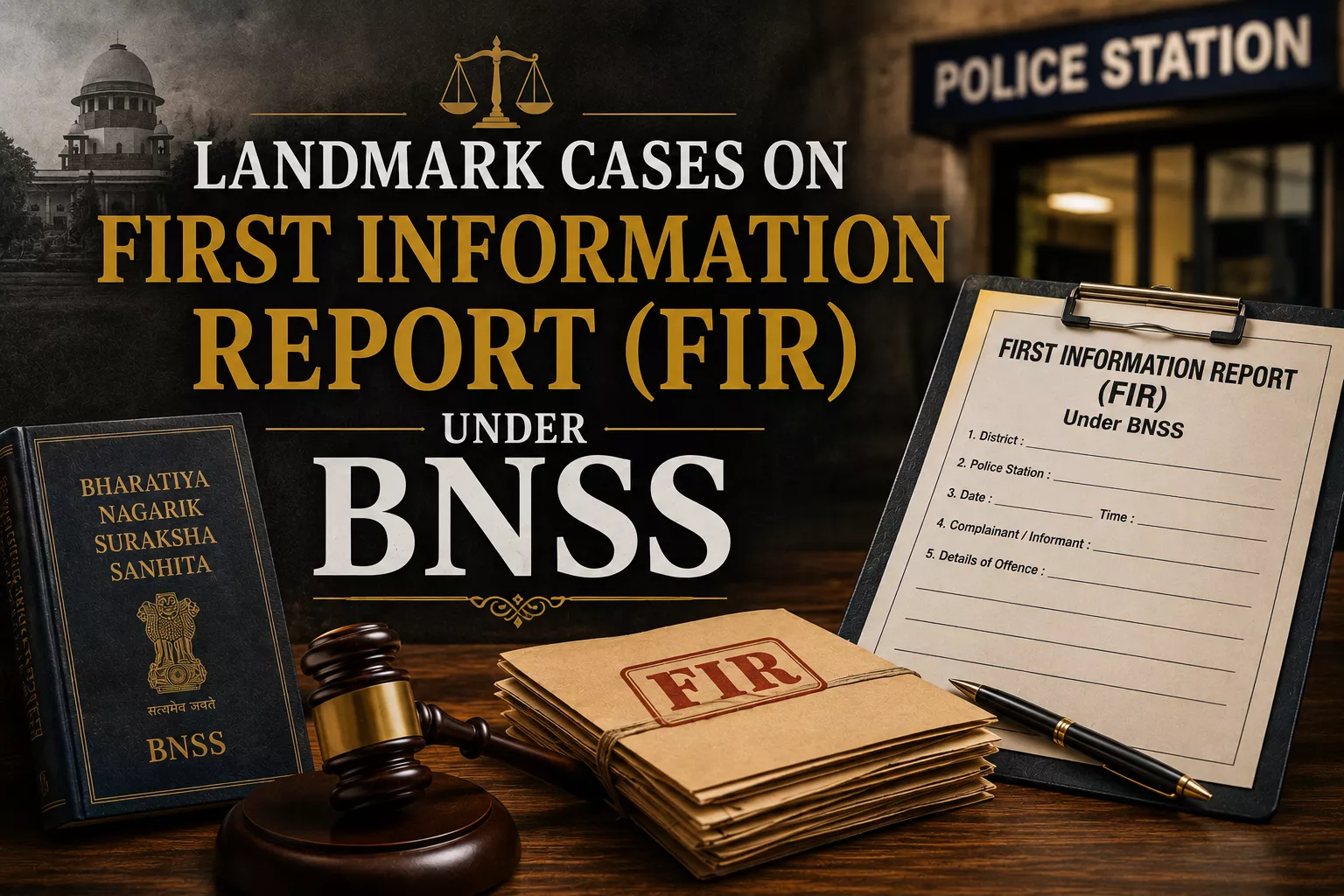
The following landmark judgments explain the concept, object, evidentiary value, registration, contents, and legal principles governing the First Information Report (FIR) under the Bharatiya Nagarik Suraksha Sanhita (BNSS). These decisions also clarify when an FIR must be registered, the scope of preliminary inquiry, delayed FIRs, telephonic information, and the evidentiary value of an FIR.
1. Agnnoo Nagesia v. State of Bihar (AIR 1966 SC 119)
Held: FIR can be used to corroborate the information under Section 157 of Indian Evidence Act (now Section 160 of BSA) or to contradict under Section 145 of Evidence Act (now Section 148 of BSA) if the informant is called as witness at the time of trial.
2. Babulal Nagamalleswara Rao v. State (2008 INSC 512)
Held: It was held that the conjoint reading of Section 157 and 159 (now Sections 176 and 178 of BNSS) clearly postulates that the purpose of sending the occurrence report is to avoid possibility in improvement of prosecution.
3. Damodarprasad Chandrikaprasad v. State of Maharashtra (1972) 1 SCC 107)
Held: It was held that FIR is an important document and it sets the criminal law in motion. It is not a substantive piece of evidence i.e. evidence of the facts recorded in it.
4. Gajanan Dashrath Kharate v. State of Maharashtra (2016) 4 SCC 604); Mukesh v. State of NCT of Delhi, (2017) 2 SCC (Cri.) 673)
Held: It was held that the object of insisting upon prompt registration of FIR is to obtain early information not only regarding the accused but also about the part played by the accused, nature of incident and name of witnesses.
5. Habib v. State of Bihar (1972) 4 SCC 773)
Held: The purpose of FIR is:
- To set the criminal law in motion
- To obtain early information of the alleged offence from the informant and put into writing before his memory fades.
6. Lalita Kumari v. Government of Uttar Pradesh (2014) 2 SCC 1)
Held: It was held that the landmark decision in Lalita Kumari v. Government of Uttar Pradesh (2014) does not create an absolute rule that a preliminary inquiry must be conducted in every case before the registration of an FIR. The Lalita Kumari decision reaffirmed the settled principle that the police authorities are obligated to register an FIR when the information received prima facie discloses a cognizable offence. The scope of a preliminary inquiry, as clarified in the said judgment, is limited to situations where the information received does not prima facie disclose a cognizable offence but requires verification. However, in cases where the information clearly discloses a cognizable offence, the police have no discretion to conduct a preliminary inquiry before registering an FIR.
7. Lalita Kumari v. Govt. of Uttar Pradesh (2013) 13 SCC 559)
Held: Registration of FIR is mandatory under Section 154 (now Section 173 of BNSS) if the information discloses the commission of a cognizable offence and no preliminary inquiry is needed in such situation. However, in certain types of cases preliminary inquiry can be conducted before registration of FIR. These cases are:-
- Matrimonial/family disputes
- Commercial offences
- Medical negligence cases
- Corruption cases
- Cases where there is abnormal delay/laches in initiating criminal proceedings.
8. Lalita v. Viswanath (2025 INSC 173)
Held: It was held that An FIR is not substantive evidence by itself unless it falls under Section 32 (dying declaration) (now Section 26 of BSA) or is used to corroborate/contradict the informant's version under Sections 157 or 145 of the Evidence Act. (now Sections 160 or 148 of BSA respectively)
9. Motiram Padu Joshi v. State of Maharashtra (2019) 9 SCC 429)
Held: It was held that Omissions as to the names of assailants or witnesses need not at all times be fatal to the prosecution if the FIR is lodged without delay.
10. N2Z v. State of Maharashtra (AIR 2022 SC 3957)
Held: Supreme Court held that it is not open to police officers to decline the registration of FIR, when a complaint disclosing commission of cognizable offence is received by them. They may file a Final Report after the completion of investigation.
11. Netaji Achyut Shinde (Patil) v. State of Maharashtra (AIR 2021 SC 1655)
Held: It was held that A phone call that is unclear or lacks complete details regarding the commission of a cognizable offence cannot necessarily be regarded as a First Information Report (FIR).
12. Patai alias Krishna Kumar v. State of Uttar Pradesh (AIR 2010 SC 2254)
Held: It was held that in order for the information to be qualified as an FIR there must be something in the nature of complaint or accusation regarding commission of a cognizable offence. A cryptic message recording an occurrence cannot be termed as an FIR.
13. Pradeep Nirankarnath Sharma v. State of Gujarat (2025 INSC 350)
Held: Preliminary inquiry before registration of FIR may be held in cases relating to matrimonial/family disputes. Preliminary inquiry does not mean to verify the veracity of information but to ascertain whether the information discloses any cognizable offence.
14. Social Action Forum for Manav Adhikar v. Union of India (2018) 10 SCC 443)
Held: It was held that Preliminary inquiry before registration of FIR may be held in cases relating to matrimonial/family disputes. Preliminary inquiry does not mean to verify the veracity of information but to ascertain whether the information discloses any cognizable offence.
15. Soma Bhai v. State of Gujarat (1973) 3 SCC 114)
Held: It was held that even a telephonic message if it discloses a cognizable offence may constitute FIR.
16. State of Haryana v. Bhajan Lal (1992 Supp (1) SCC 335)
Held: The word "information" in Section 154 (now Section 173 of BNSS) is not qualified by the term 'reasonable' or 'credible'. By omitting the word 'reasonable' and 'credible' the intent of legislature is clear that no discretion is given to the police to lodge the FIR.
17. State of M.P. v. Chhaakki Lal (2019) 12 SCC 326)
Held: FIR is not an encyclopaedia requiring every minute details of occurrence to be mentioned therein.
18. State of U.P. v. Raghuraj (2018) 13 SCC 732)
Held: It was held that Delay in lodging FIR is normally viewed with suspicion because of possibility of concoction and courts subject the evidence with close scrutiny.
19. Satpal v. State of Haryana (2018) 6 SCC 610); Latesh v. State of Maharashtra (2018) 3 SCC 66); Sunil Kshyapde v. State of Maharashtra (2016) 15 SCC 773)
Held: First information report need not necessarily contain details of each and every injury sustained by the deceased.