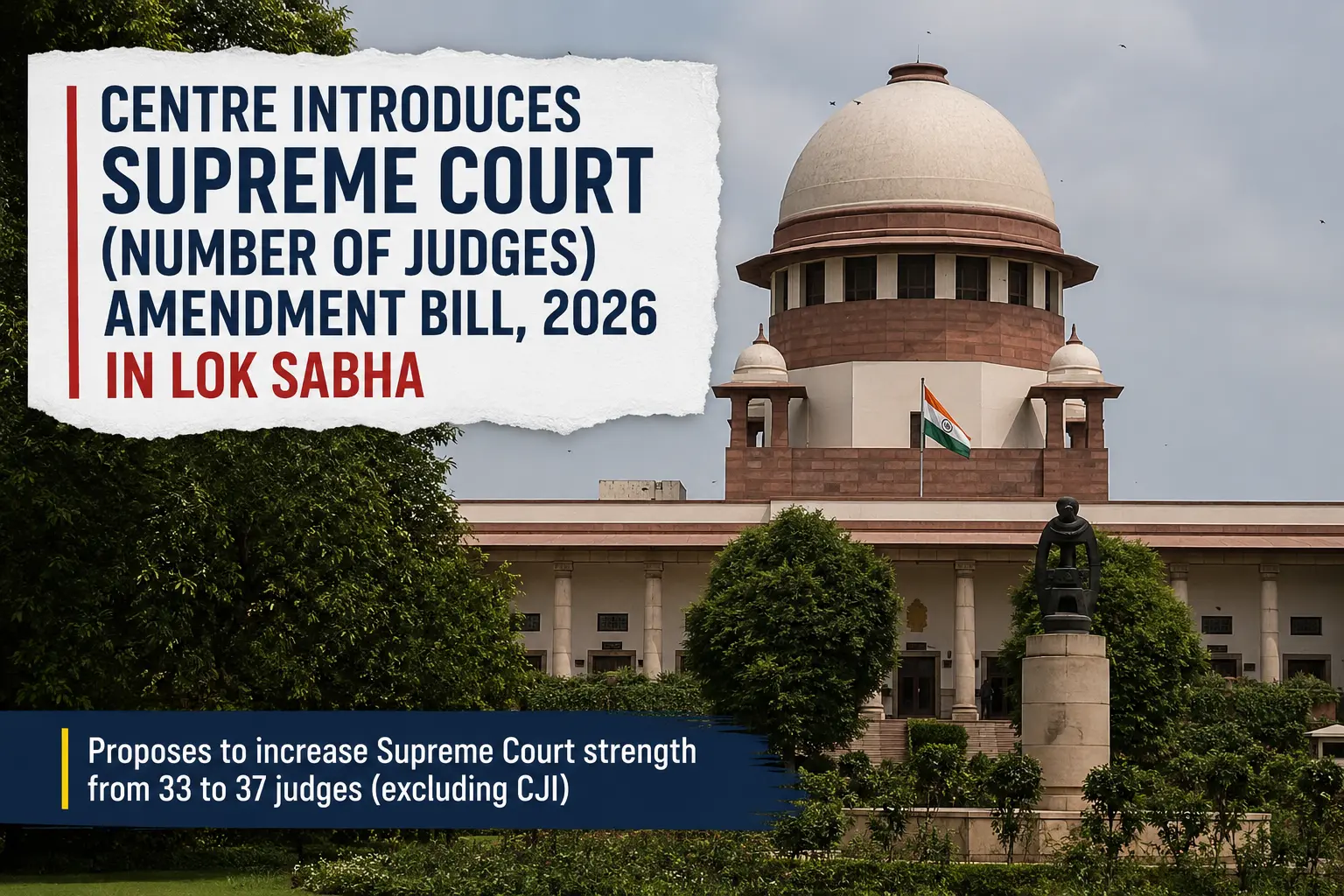
The Central Government on Monday introduced the Supreme Court (Number of Judges) Amendment Bill, 2026 in the Lok Sabha during the Monsoon Session of Parliament. The proposed legislation seeks to increase the authorised strength of judges in the Supreme Court from 33 to 37, excluding the Chief Justice of India (CJI). If implemented, the total sanctioned strength of the apex court, including the CJI, will rise to 38 judges.
The Bill was introduced by Union Law Minister Arjun Ram Meghwal, who presented it in the Lok Sabha as part of the government's legislative agenda for the ongoing session. The proposal follows an ordinance issued earlier by the Centre that had already provided for the same increase in the number of judges. The Bill is intended to replace that ordinance through parliamentary approval.
According to the government, the amendment is limited to increasing the maximum permissible number of Supreme Court judges. It does not alter the powers, jurisdiction, constitutional role, or the process of appointment of judges to the Supreme Court. The objective is to ensure that additional judges can be appointed whenever required in the future, enabling the judiciary to meet increasing demands.
Despite the proposed enhancement in the sanctioned strength, the Supreme Court is presently functioning with fewer judges than even the earlier approved limit. The amendment is therefore aimed at providing greater flexibility for future appointments as and when vacancies arise.
The Bill was introduced amid a noisy Monsoon Session of Parliament. Proceedings in the Lok Sabha witnessed repeated disruptions as Opposition members raised protests over issues including the NEET-UG paper leak and allegations related to the Ram Mandir donation scam. Due to the uproar, the House was adjourned first till 12:30 pm and later until 2:00 pm before legislative business resumed.
If passed by Parliament, the Supreme Court (Number of Judges) Amendment Bill, 2026 will formally increase the authorised strength of the Supreme Court from 34 (including the Chief Justice) to 38 (including the Chief Justice), while leaving all other constitutional and administrative aspects of the apex court unchanged.