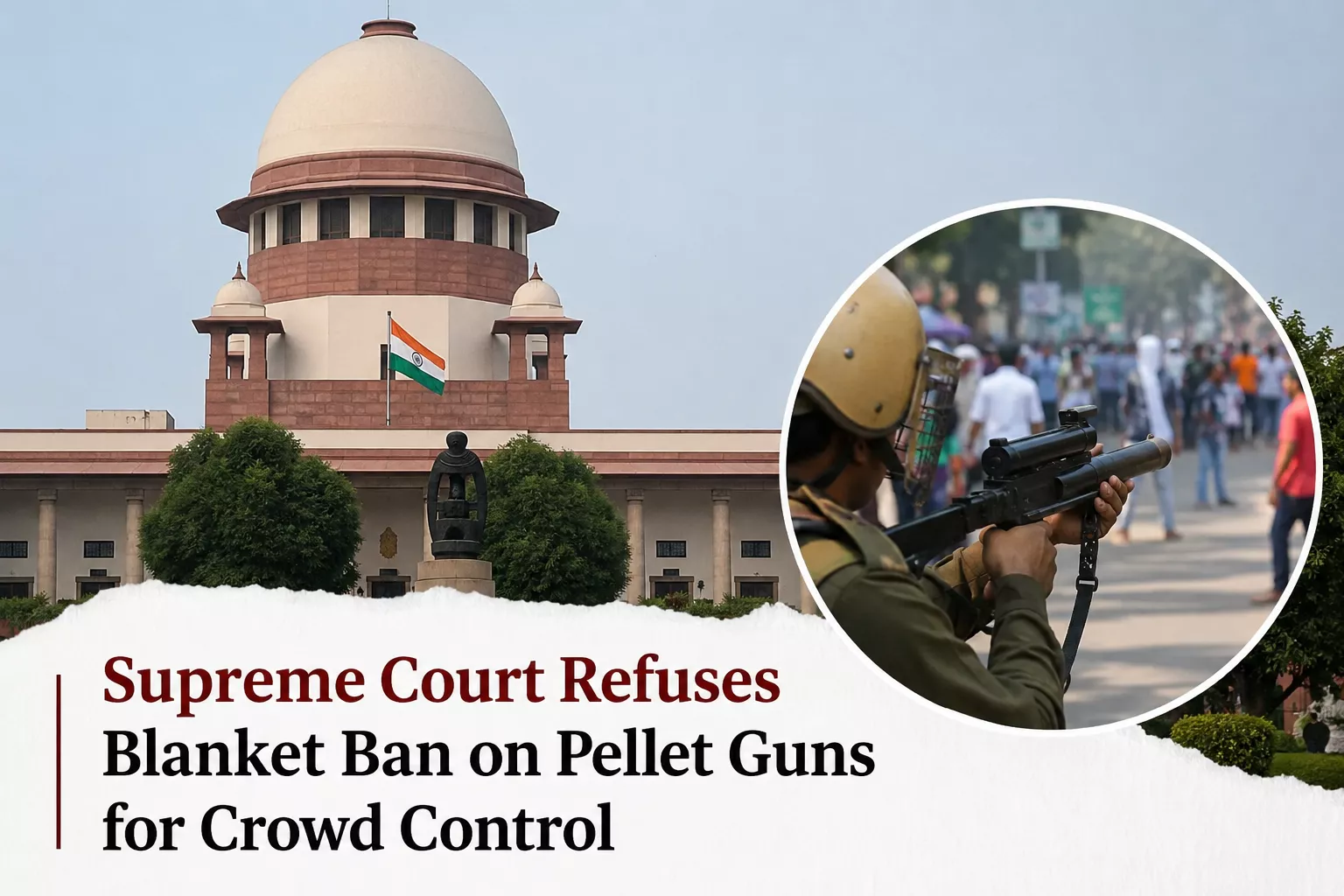
The Supreme Court on Thursday declined to impose a blanket ban on the use of pellet guns for crowd control, observing that such a prohibition cannot be ordered without examining the specific facts and circumstances in which force is used by law enforcement authorities.
A Bench hearing petitions arising out of the recent protests in Delhi questioned how the Court could completely prohibit pellet guns when the police are legally empowered to use firearms in extreme situations. The judges observed that if the law permits the use of bullets under exceptional circumstances, it would be difficult to justify an absolute ban on pellet guns without considering the context in which they are deployed.
During the hearing, the Court emphasized that both protesters and police personnel are human beings and that the legal system must balance the rights and safety of everyone involved. It noted that crowd control situations often require difficult decisions, and any assessment of the use of force must take into account the facts of each individual case rather than adopting a one-size-fits-all approach.
The plea before the Court sought a complete prohibition on the use of pellet guns against civilians during protests, arguing that the weapons have caused severe injuries in several instances and are inconsistent with the principle of using the minimum necessary force. The petitioners also raised concerns over the injuries allegedly sustained by protesters during the recent demonstrations at Jantar Mantar in Delhi.
While refusing to grant an immediate blanket ban, the Supreme Court made it clear that the legality of the use of pellet guns in a particular incident can still be examined based on the circumstances of that case. The Court indicated that any misuse or excessive use of force by authorities would remain subject to judicial scrutiny.)
At the same time, the Bench expressed concern for those injured during the protests and directed the Delhi Government to ensure that all persons who sustained injuries receive appropriate medical treatment. The Court underscored that providing medical care to the injured is an immediate humanitarian obligation irrespective of the outcome of the legal proceedings.
The matter remains under consideration, and the Supreme Court is expected to continue examining issues relating to the use of force during the protests, including the circumstances surrounding the deployment of pellet guns by security personnel.