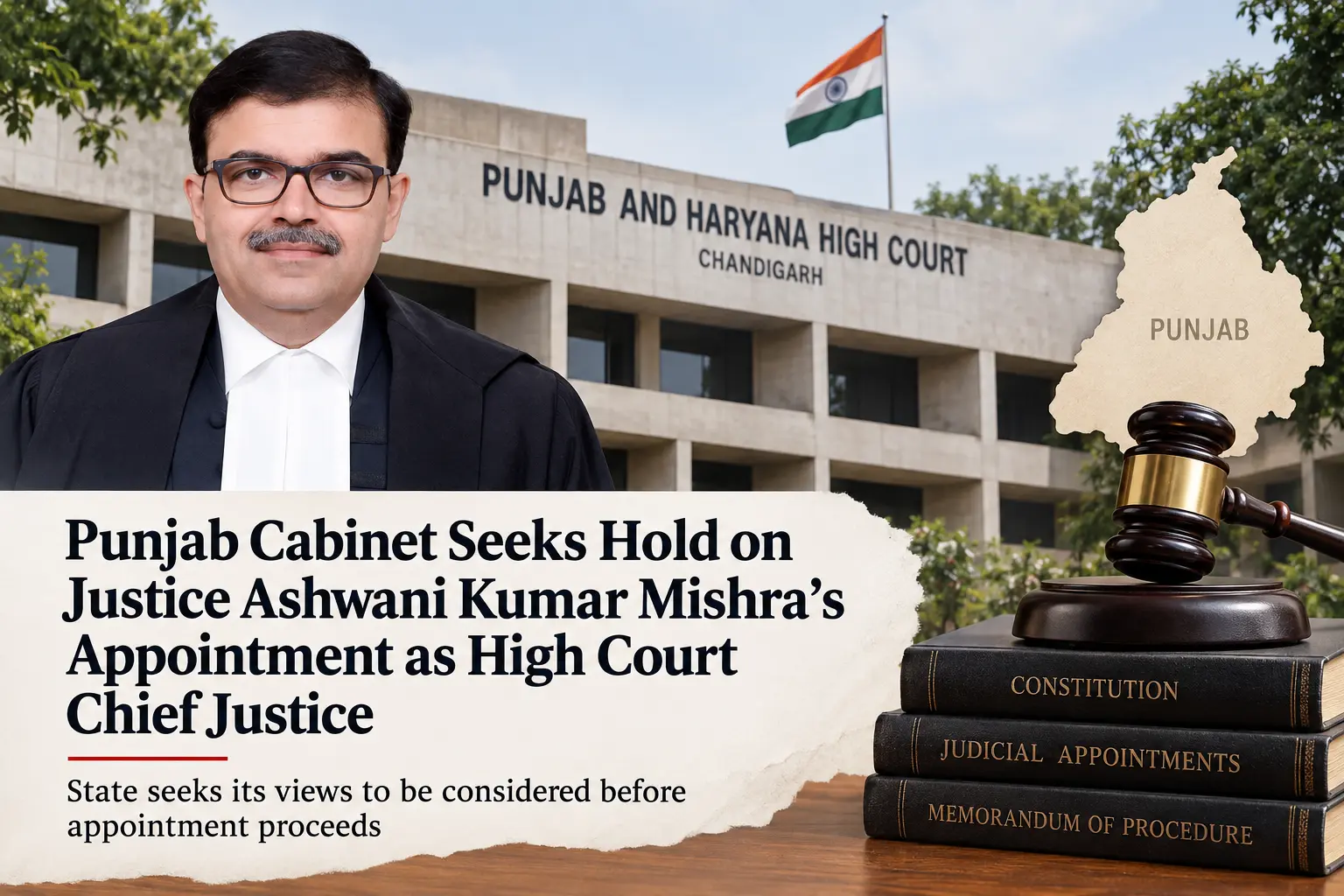
The Punjab Cabinet has raised objections to the appointment of Justice Ashwani Kumar Mishra as the Chief Justice of the Punjab and Haryana High Court, alleging that the Union Government proceeded with the appointment without awaiting the views of the Punjab Government. At an emergency meeting chaired by Chief Minister Bhagwant Mann, the Cabinet passed a resolution seeking that both the appointment and the administration of oath be kept on hold until the State’s views are obtained and considered.
Justice Ashwani Kumar Mishra has been functioning as the Acting Chief Justice of the Punjab and Haryana High Court since June, following the elevation of Justice Sheel Nagu to the Supreme Court. The Supreme Court Collegium, headed by Chief Justice of India Surya Kant, recommended Justice Mishra for appointment as the permanent Chief Justice on August 6, 2026. The Union Government subsequently notified his appointment on September 5.
The Punjab Government has contended that the prescribed Memorandum of Procedure requires the views of the concerned State Government to be obtained before the proposal is placed before the Prime Minister and subsequently sent to the President for appointment. Punjab has argued that proceeding without receiving its response amounted to bypassing the established procedure and the State’s constitutional role.
Chief Minister Bhagwant Mann also connected the issue with other ongoing disputes between Punjab and the Centre, including the withholding of approximately ₹9,000 crore under the Rural Development Fund, the demand for flood relief and changes concerning the Bhakra Beas Management Board. Punjab Finance Minister Harpal Singh Cheema similarly accused the Centre of disregarding the prescribed process.
However, the controversy has also attracted criticism from opposition parties and legal observers. The Shiromani Akali Dal has cautioned that questioning judicial appointments could affect judicial independence and the separation of powers. Legal experts have pointed out that while the State Government’s views are required to be sought, the Memorandum of Procedure does not expressly make the State’s consent a condition for appointment. The present dispute therefore centres largely on whether the Centre could proceed while Punjab’s response was still awaited.