Table of Contents
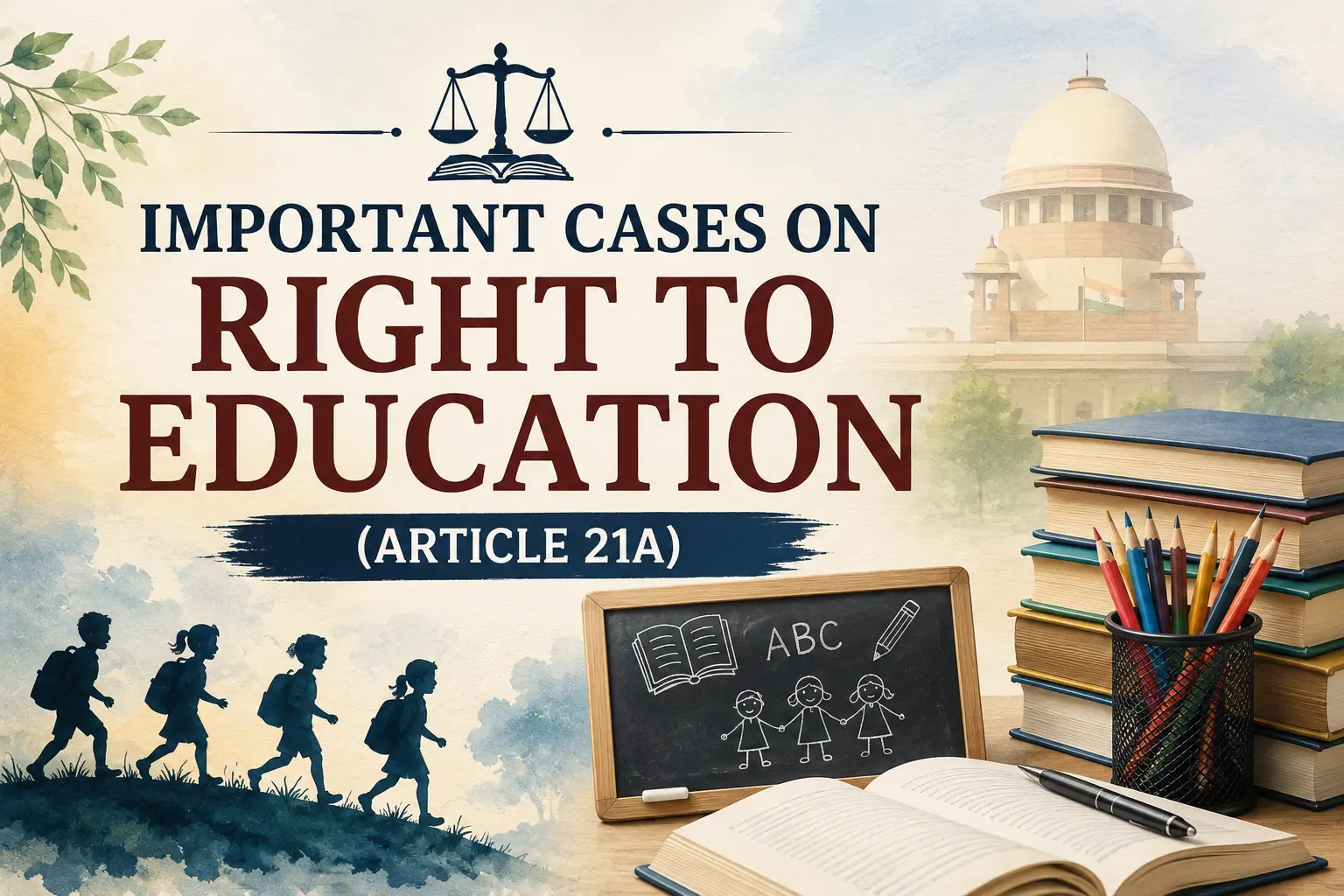
The following landmark judgments explain the scope of the Right to Education under Article 21A of the Constitution of India. These decisions clarify that education is a fundamental right and deal with issues relating to free and compulsory education, quality education, and the obligations of the State.
1. A.A. Padmanabhan v. State of Kerala (AIR 2018 SC 2982)
Held: It was held that Under Article 21-A of the Constitution and the Right of Children to Free and Compulsory Education Act, 2009, the State is responsible for ensuring that children up to 14 years of age receive primary education. The State's decision to take over and operate primary schools that were set to be closed by their management was made in the public interest and for the benefit of education. Therefore, the High Court correctly declined to interfere with the State Government's decision to directly manage these schools.
2. Bhartiya Seva Samaj Trust v. Yogeshbhai Ambalal Patel (AIR 2012 SC 3285)
Held: It was held that The right to education is a fundamental right derived from Article 21 of the Constitution. In Ashoka Kumar Thakur v. Union of India (2008), while addressing the issue of reservation, the Supreme Court referred to Articles 15(3) and 21-A, emphasizing that without Article 21-A, other fundamental rights lose their significance. Therefore, it is essential to diligently implement Article 21-A to uphold the right to education effectively.
3. Mohini Jain v. State of Karnataka (1992) 3 SCC 666)
Held: Supreme Court held that right to education at all levels is a fundamental right flowing from Article 21.
4. State of Tamil Nadu v. K. Shyam Sundar (2011) 8 SCC 737)
Held: Supreme Court held that the right to education should be extended to have quality education without discrimination on the ground of economic, social and cultural backgrounds.
The right to education under Article 21A must be interpreted in alignment with Articles 14 and 15, ensuring no discrimination in the quality of education. Every child has the right to learn, which should not be limited to free and compulsory education but must also include access to quality education without discrimination based on economic, social, or cultural background.
5. Unni Krishnan v. State of A.P. (1993) 1 SCC 645)
Held: Supreme Court held that right to education is a fundamental right flowing from Article 21 but right to free education is available to the children until they complete the age of 14 years. After that the obligation of State to provide education is subject to economic capacity and development.