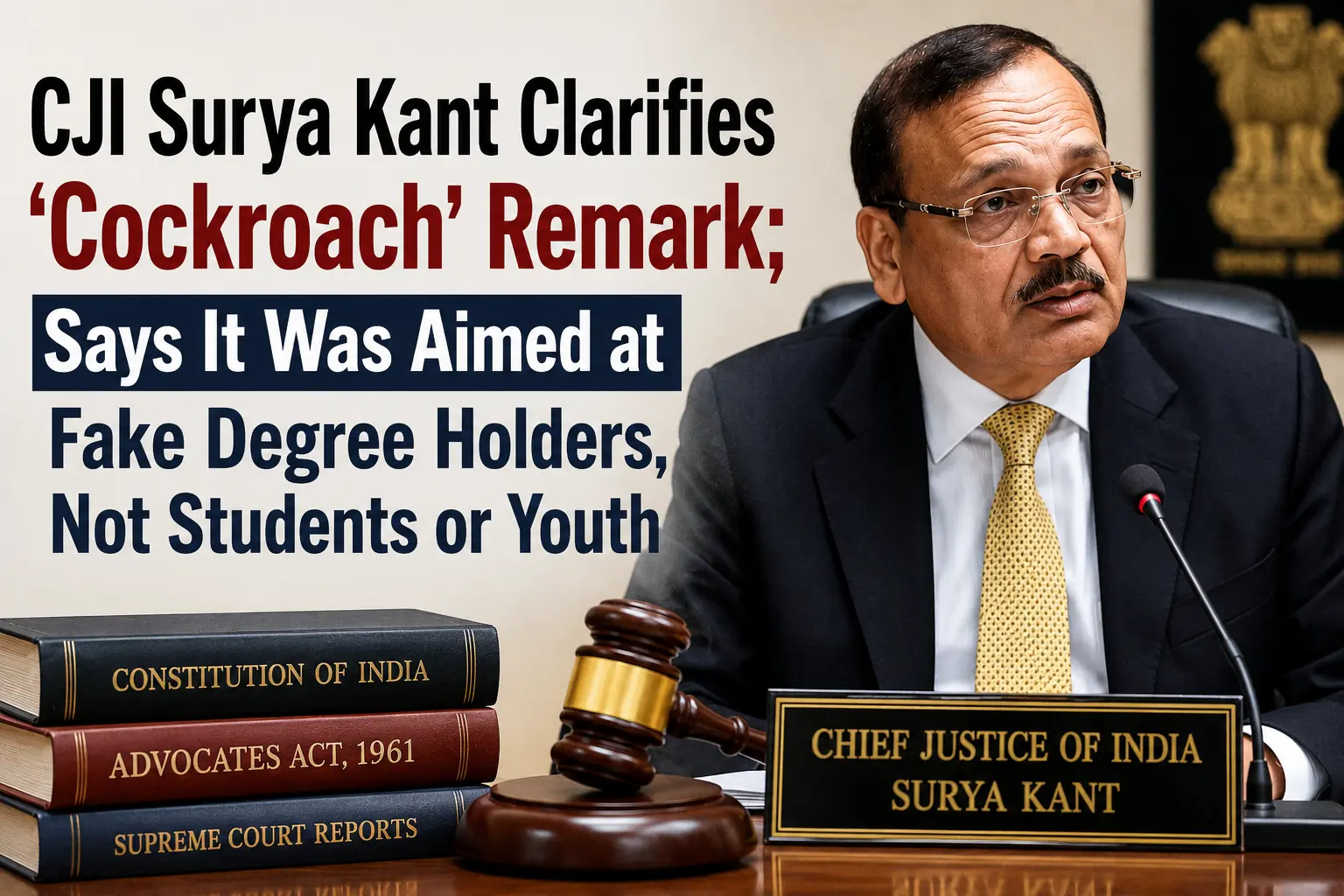
Chief Justice of India (CJI) Surya Kant has clarified that his controversial "cockroach" remark was never directed at students, unemployed youth, or the younger generation. According to the CJI, his observations were specifically aimed at individuals who enter professional fields, particularly the legal profession, by using fake or bogus degrees.
Issuing a clarification, Justice Surya Kant expressed disappointment over the manner in which a section of the media reported his oral observations. He said that his remarks had been taken out of context and wrongly portrayed as criticism of students and unemployed youth, resulting in widespread misunderstanding.
The Chief Justice explained that his observations were made during the hearing of a matter concerning the growing problem of fake law degrees. He said his concern was with individuals who fraudulently obtain or use fake educational qualifications to enter professions such as law and even the media, thereby compromising the integrity and credibility of these professions. According to him, such individuals deserve criticism, not genuine students or unemployed young people.
Justice Surya Kant said he was "pained" to see media reports suggesting that he had referred to unemployed youth as "cockroaches." He categorically stated that his remarks had been misquoted and misrepresented. Reiterating his position, the CJI said his criticism was solely directed at those who secure professional opportunities through fake or bogus degrees and then attack institutions without adhering to professional ethics.
He further emphasised that India's youth should not be judged through the controversy created by selective reporting. The Chief Justice maintained that he has always respected the aspirations of young people and that his observations should not be interpreted as comments against students, unemployed individuals, RTI activists, or the youth at large.
The clarification comes after his courtroom remarks sparked widespread public debate and criticism on social media, where many believed they were aimed at unemployed youth. The CJI has now made it clear that this interpretation is incorrect and that his observations were confined to individuals allegedly entering professional fields by relying on fake educational qualifications.
By issuing this clarification, Justice Surya Kant sought to remove any ambiguity surrounding his remarks and reaffirmed that his concern is the growing misuse of fake degrees in professional fields, particularly in the legal profession, and not India's students, unemployed youth, or the younger generation.