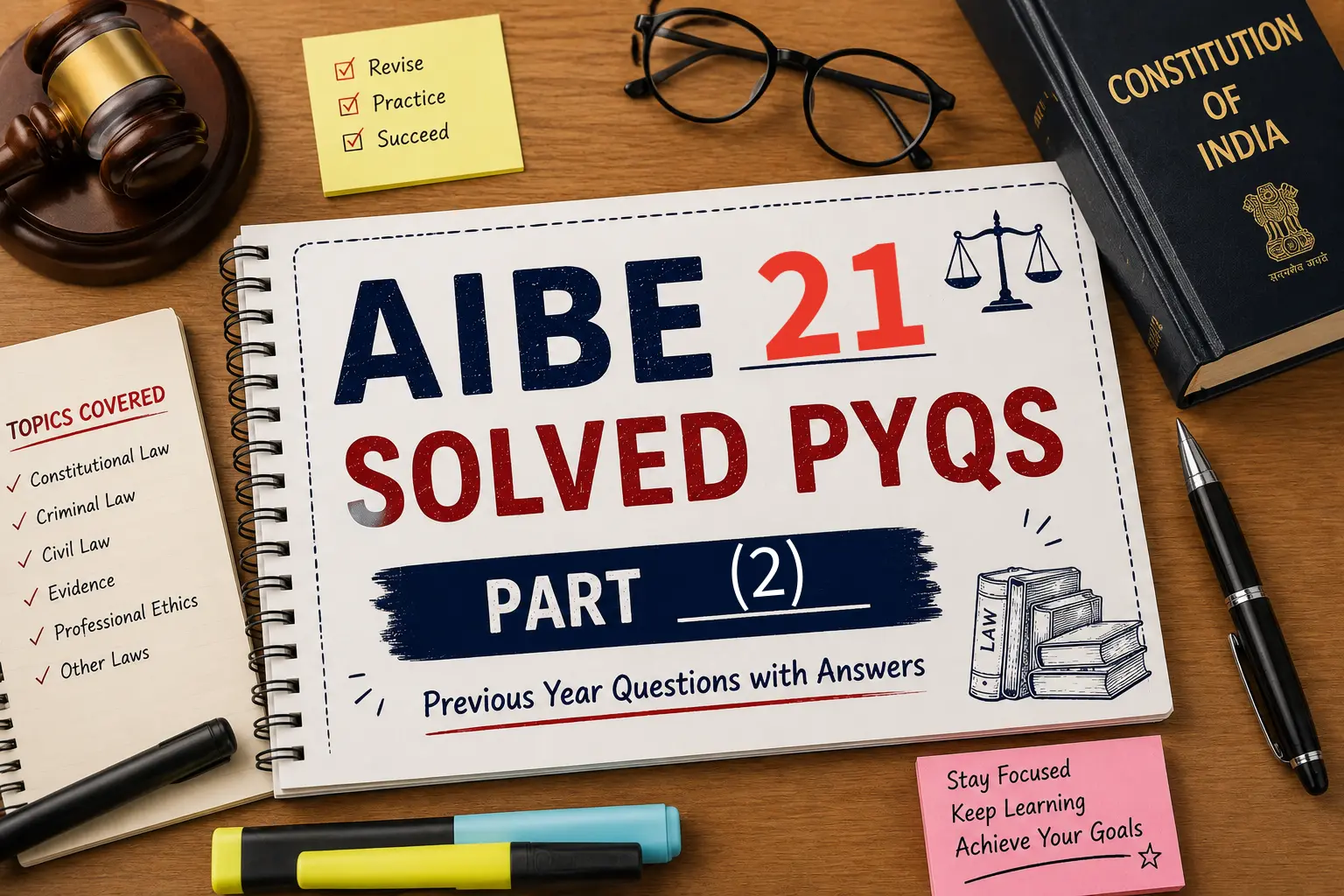
Practice the AIBE 21 (2026) Part 2 Solved Question Paper with all 100 original multiple-choice questions and official answer key-based solutions. An excellent resource for AIBE preparation and revision.
Access Part 1 :- AIBE 21 (2026) Solved
Q51. In accordance with the provisions of the Code of Civil Procedure, 1908, where a court, while examining the court, finds certain averments to be unnecessary and capable of prejudicing or delaying the fair trial, the court may:
(A) Strike out such pleadings at any stage of proceedings.
(B) Direct amendment only after trial begins.
(C) Ignore such pleadings without passing any order.
(D) Reject the plaint in entirety.
Answer: (A)
Q52. During an India–Country X war, India declares X an enemy. A (an Indian citizen) enters into a contract to supply medicines to B (a citizen of X) via a neutral intermediary and a bank. Which of the following is most accurate under the Indian Contract Act, 1872?
(A) Valid – goods are humanitarian and payment is via a neutral country.
(B) Valid unless the Government expressly cancels.
(C) Voidable – only the Government of India can cancel.
(D) Void – trading with an enemy in war is prohibited and is against public policy.
Answer: (D)
Q53. Section 233 of the Companies Act, 2013, deals with "fast track merger". What is the time duration and the concerned authority for approval?
(A) 60–90 Days, NCLT
(B) 1 Year, Regional Director
(C) 45–90 Days, NCLAT
(D) 60–90 Days, Regional Director
Answer: (D)
Q54. A contracts with B to construct a cold storage facility for ₹50 lakh within 6 months. After the expiry of the time period, B fails to perform the contract. A immediately hires C to complete the construction at ₹60 lakh and later files a suit against B claiming ₹10 lakh as the additional cost incurred. Which of the following statements is correct under the Specific Relief Act, 1963?
(A) A can recover only if the court first declares B guilty of breach.
(B) A must sue only for damages and not substituted performance.
(C) A can recover ₹10 lakh because B breached the contract.
(D) A cannot recover the cost because A did not give B prior notice.
Answer: (C)
Q55. A mandatory PUC Certificate is provided under which Section and Rule?
(A) Section 190(2) of the Motor Vehicles Act, 1988 and Rules 115 and 116 of the Central Motor Vehicles Rules, 1989.
(B) Section 177(3) of the Motor Vehicles Act, 1988 and Rules 117 and 118 of the Central Motor Vehicles Rules, 1989.
(C) Section 190(1) of the Motor Vehicles Act, 1988 and Rules 109 and 110 of the Central Motor Vehicles Rules, 1989.
(D) Section 120(3) of the Motor Vehicles Act, 1988 and Rules 122 and 123 of the Central Motor Vehicles Rules, 1989.
Answer: (A)
Q56. Judicial intervention in arbitration proceedings is limited under Section 5 of the Arbitration and Conciliation Act, 1996. In which of the following situations may a court intervene?
(A) When both parties request supervision of proceedings.
(B) When procedural irregularity is alleged without specific provision under the Act.
(C) When the court considers the award unjust on facts.
(D) When the Act expressly permits such intervention.
Answer: (D)
Q57. Which of the following is not a document as per the Bharatiya Sakshya Adhiniyam, 2023?
(A) Private papers
(B) Caricature
(C) Map
(D) Inscription
Answer: (A)
Q58. A State Government plans to acquire 50 acres of Scheduled Tribes (ST) land for an industrial park. As per the applicable law, the following stages are proposed:
(i) Preliminary notification
(ii) Social Impact Assessment (SIA)
(iii) Gram Sabha consultation/consent
(iv) Final notification
Which of the following statements is correct?
(A) Final notification can be issued without Gram Sabha, with owner consent only.
(B) Final notification can come before SIA but after preliminary notification.
(C) SIA and Gram Sabha consultation/consent are mandatory for ST land; acquisition cannot proceed without consent.
(D) Gram Sabha is advisory only; consent is not needed for public projects.
Answer: (C)
Q59. Under the Bharatiya Nyaya Sanhita (BNS), 2023, "Forfeiture of Property" is listed as a punishment. In which specific case is this most commonly applied?
(A) Organized Crime (Section 111)
(B) Offences involving simple hurt or minor physical injury
(C) Cases of rash or negligent driving
(D) Instances of minor or petty theft
Answer: (A)
Q60. According to the provisions of the Bharatiya Nagarik Suraksha Sanhita (BNSS), 2023, an accused person intending to apply for 'Plea Bargaining' must do so within how many days following the formal framing of charges?
(A) 7 days
(B) 15 days
(C) 30 days
(D) 60 days
Answer: (C)
Q61. The five Golden Principles with respect to Circumstantial Evidence were laid down in which Supreme Court Judgment?
(A) Sharad Birdhichand Sarda v. State of Maharashtra, 1984 AIR 1622
(B) Vasa Chandrasekhara Rao v. Ponna Satyanarayana & Anr., 2000 AIR SC 2138
(C) Dudh Nath Pandey v. State of U.P., 1981 SCC (2) 166
(D) Dr. Sunil Clifford Daniel v. State of Punjab (2012) 11 SCC 205
Answer: (A)
Q62. Which of the following does not fall under the framework of presumption under Section 2 of the Bharatiya Sakshya Adhiniyam, 2023?
(A) Conclusive proof
(B) Unassailable proof
(C) May be
(D) Shall presume
Answer: (B)
Q63. Directives: The following question consists of two statements, one labelled as Assertion (A) and the other labelled as Reason (R).
Assertion (A): Income-tax is levied on the total income of a person for the previous year.
Reason (R): Income earned during the previous year is assessed to tax in the immediately succeeding assessment year under the Income-tax Act, 1961.
(A) (A) is false, but (R) is true.
(B) Both (A) and (R) are true, but (R) is not the correct explanation of (A).
(C) Both (A) and (R) are true.
(D) (A) is true, but (R) is false.
Answer: (C)
Q64. Under the Indian Christian Marriage Act, 1872, between which hours must a marriage generally be solemnized?
(A) Between seven in the morning and eight in the evening
(B) Between five in the morning and six in the evening
(C) Between six in the morning and seven in the evening
(D) Between six in the morning and nine in the evening
Answer: (C)
Q65. A, an 18-year-old adult of sound mind, executes a written instrument in favour of B stating, "I promise to pay B ₹75,000 on 1st April next year." A is fully competent, has signed the note, and the instrument contains all essential elements of a promissory note. B sues A for recovery on 1st April when A defaults. Examine the most legally sound position.
(A) The promissory note is valid; A is liable to pay B.
(B) The promissory note is voidable at A's option since A is only 18 years of age.
(C) The promissory note is valid only if a third party signs as witness.
(D) The promissory note is void because it does not mention the consideration.
Answer: (A)
Q66. Under which specific provision of the Bharatiya Nyaya Sanhita (BNS), 2023, has the definition of a "Terrorist Act" been formally integrated into India's general penal legislation for the first time?
(A) Section 113
(B) Section 152
(C) Section 109
(D) Section 121
Answer: (A)
Q67. Directives: The following question consists of two statements, one labelled as Assertion (A) and the other labelled as Reason (R).
Assertion (A): The right to privacy has been judicially recognised as an integral part of Article 21 of the Constitution of India.
Reason (R): Privacy is expressly enumerated as a separate Fundamental Right in Part III of the Constitution of India.
(A) (A) is false, but (R) is true.
(B) Both (A) and (R) are true, but (R) is not the correct explanation of (A).
(C) Both (A) and (R) are true, and (R) is the correct explanation of (A).
(D) (A) is true, but (R) is false.
Answer: (D)
Q68. Under constitutional jurisprudence in India, repeated re-promulgation of Ordinances without placing them before the Legislature was described by the Supreme Court as a "fraud on the Constitution" in which decision?
(A) R.C. Cooper v. Union of India, AIR 1970 SC 564
(B) Shamsher Singh v. State of Punjab, AIR 1974 SC 2192
(C) Krishna Kumar Singh v. State of Bihar, (2017) 3 SCC 1
(D) D.C. Wadhwa v. State of Bihar, AIR 1987 SC 579
Answer: (D)
Q69. The Supreme Court of India in Harish Chandra Tiwari v. Baiju, (2002) 2 SCC 67, while considering the appropriate punishment for misappropriation of a client's money by an advocate, held that:
(A) A monetary penalty equal to double the amount misappropriated is the appropriate sanction under the Act.
(B) Reprimand is the appropriate punishment for a first-time misappropriation, since removal from the roll would be disproportionate.
(C) Suspension from practice for a period of five years is the standard sanction for misappropriation of client funds.
(D) Misappropriation of a client's money constitutes one of the gravest forms of professional misconduct, and ordinarily warrants removal of the advocate's name from the State roll.
Answer: (D)
Q70. According to Section 56(2)(x) of the Income-tax Act, 1961, if an individual receives a sum of money, without consideration, from a person other than a relative, and the amount exceeds the prescribed limit, what is the correct legal position?
(A) It is taxable under the head "Income from Other Sources".
(B) It is fully exempt from tax.
(C) It is treated as a capital receipt and is not taxable.
(D) It is taxable only if received in cash.
Answer: (A)
Q71. Under the Constitution of India, Parliament enacts legislation to implement India's obligation under an international environmental agreement. The subject ordinarily falls within the State List and no resolution under Article 252 has been passed. The source of Parliament's competence would be:
(A) Article 250
(B) Article 253
(C) Article 249
(D) Article 252
Answer: (B)
Q72. Under the Indian Penal Code (IPC), 1860, in which of the following scenarios does the "Right of Private Defence of the Body" extend to the voluntary causing of death to the assailant?
(A) An assault committed with the specific intention of kidnapping or abducting a person.
(B) A case of theft where the value of the stolen property exceeds ₹10,000.
(C) An act of criminal trespass occurring on open, vacant land.
(D) A simple assault committed without the use of a weapon.
Answer: (A)
Q73. In the following question, a Statement is followed by two Conclusions, I and II.
Statement: Allegations have been made by the Minority Shareholders that ABC's promoters sold the company's optionally convertible preference shares and redeemable preference shares to a trust controlled by the promoters at prices significantly below their fair market value, thereby causing a financial loss to ABC and its shareholders. What is the recourse for minority shareholders under law?
Conclusion I: The Minority Shareholders can file for class action under Section 245 of the Companies Act, 2013, seeking directions from NCLT to either reverse the sale of optionally convertible preference shares and redeemable preference shares or to compensate the Minority Shareholders.
Conclusion II: The aggrieved members may proceed individually to protect their rights against acts of oppression or mismanagement under Section 241 of the Companies Act, 2013.
(A) Neither Conclusion I nor II follows.
(B) Only Conclusion I follows.
(C) Only Conclusion II follows.
(D) Both Conclusions I and II follow.
Answer: (D)
Q74. The adoption of an Ombudsman-type institution in India was first recommended by which of the following?
(A) Santhanam Committee, 1964
(B) Administrative Reforms Commission, 2005
(C) Administrative Reforms Commission, 1966
(D) India Against Corruption Movement, 2011
Answer: (C)
Q75. X takes a loan of ₹10,00,000 from Bank A. Y signs a contract as surety, promising to pay the bank if X defaults. After 3 months, Bank A agrees to reduce the interest rate and extends the repayment period by 6 months without informing Y. Subsequently, X defaults on the loan. Which of the following statements correctly describes Y's liability under the Indian Contract Act, 1872?
(A) Y is liable only if the bank sues the principal debtor first, regardless of the modification.
(B) Y is not liable at all because the principal debtor defaulted after the contract modification.
(C) Y is partially discharged from liability because Bank A's modification increased the risk to Y without his consent.
(D) Y is fully liable for the entire loan because a surety is always liable once the principal debtor defaults.
Answer: (C)
Q76. Whether a landowner who enters into a Joint Development Agreement with a builder, contributing land in exchange for 50% of the developed property and a monetary deposit, can file a complaint under the Consumer Protection Act, 2019 alleging construction defects and delay? Which of the following statements is most accurate?
(A) The landowner is a consumer as he did not construct himself.
(B) The landowner is a consumer unless profit motive is proven.
(C) The landowner is not a consumer as the transaction constitutes a commercial joint venture.
(D) The landowner is a consumer if defects exist, irrespective of the nature of the transaction.
Answer: (C)
Q77. Pursuant to the definition provided in Section 378 of the Indian Penal Code (IPC), 1860, which of the following constitutes an essential element of the offence of 'Theft'?
(A) The movement of movable property out of a person's possession without their consent.
(B) The requirement that the property must be removed from a public location exclusively.
(C) The employment of physical force or criminal violence against a person.
(D) The unauthorized movement of immovable property without the owner's consent.
Answer: (A)
Q78. Under the constitutional framework of India, the Supreme Court gradually relaxed the traditional rule of locus standi, thereby allowing public-spirited individuals to approach the Court for enforcement of fundamental rights of others. This development is most closely associated with:
(A) The evolution of Public Interest Litigation.
(B) Judicial review of administrative action.
(C) Enforcement of fundamental rights through individual petitions alone.
(D) Expansion of writ jurisdiction under Article 226.
Answer: (A)
Q79. Ramesh's job contract with M/s XYZ bars him from joining any rival software firm in India for three years post-resignation. But after resigning within three years, he joins a competitor. XYZ company filed a suit to enforce the restrictive clause. Under the Indian Contract Act, 1872, what is the legal position?
(A) Void – restrains lawful profession after employment ends.
(B) Valid – Ramesh agreed voluntarily.
(C) Valid – protects the employer's business interest.
(D) Valid – three years is a reasonable period.
Answer: (A)
Q80. Under Rule 8 of the Standards of Professional Conduct and Etiquette framed by the Bar Council of India, an advocate is prohibited from appearing before any court, tribunal or authority for or against an organisation or institution of which he is a member of its:
(A) Advisory Committee
(B) Sub-Committee
(C) Executive Committee
(D) General Body
Answer: (C)
Q81. Which of the following is not included in "The Industrial Relations Code, 2020"?
(A) Industries (Development and Regulation) Act, 1951 (IDR Act)
(B) Industrial Employment (Standing Orders) Act, 1946
(C) Trade Unions Act, 1926
(D) Industrial Disputes Act, 1947
Answer: (A)
Q82. Under the Special Marriage Act, 1954, what is the maximum fine that may be imposed for printing or publishing matter in contravention of provisions relating to in-camera proceedings?
(A) Fine up to five thousand rupees
(B) Fine up to one thousand rupees
(C) Fine up to two thousand rupees
(D) Fine up to five hundred rupees
Answer: (B)
Q83. In the following question, a Statement is followed by two Conclusions, I and II.
Statement: The Bar Council of India derives its rule-making power from Section 49(1)(c) of the Advocates Act, 1961, which authorises it to frame rules governing professional conduct and etiquette to be observed by advocates. Rule 20 framed thereunder categorically bars an advocate from stipulating for or receiving any fee whose quantum is dependent upon the outcome of litigation, or from entering into any arrangement to share in its proceeds. An advocate who contravenes this Rule is liable to be proceeded against under Section 35 of the Advocates Act, 1961.
Conclusion I: An advocate may lawfully enter into an outcome-linked fee arrangement so long as the client's written consent is obtained prior to the engagement.
Conclusion II: An advocate who violates the prohibition on contingency-based fees may face disciplinary action under the Advocates Act, 1961.
(A) Only Conclusion II follows.
(B) Both Conclusions I and II follow.
(C) Neither Conclusion I nor II follows.
(D) Only Conclusion I follows.
Answer: (A)
Q84. Under the Patents Act, 1970, a patent is granted to an inventor in India. Which of the following correctly reflects a limitation on the patentee's rights under the law?
(A) The invention cannot be used by the Government without permission.
(B) The patent becomes void if used by a government authority.
(C) The Government may use the invention for its own purposes without the consent of the patentee.
(D) The patentee loses all rights once the invention is used by the Government.
Answer: (C)
Q85. Under the Information Technology Act, 2000, the term "electronic record" includes which of the following?
I. Data stored in digital form.
II. Image or sound stored or transmitted electronically.
III. Information generated in microfilm or computer-generated microfiche.
IV. Information recorded only on paper without electronic processing.
Which of the above are correct?
(A) I and II
(B) I, II and III
(C) I, II, III and IV
(D) II, III and IV
Answer: (B)
Q86. A executes a document in favour of B stating, "I hereby sell my house to B for ₹5,00,000. If I repay the amount within 3 years, B shall retransfer the property to me; otherwise, the sale shall become absolute." The condition is included in the same document. A fails to repay within 3 years. B claims absolute ownership. Examine the correct legal position under the Transfer of Property Act, 1882.
(A) It is a mortgage by conditional sale; B must seek foreclosure through court.
(B) It is a lease with an option to repurchase.
(C) The transaction is void for uncertainty.
(D) It is an outright sale; B becomes absolute owner.
Answer: (A)
Q87. Under the scheme of the Code of Civil Procedure, 1908, where proceedings are pending before a competent civil court, and an application is made seeking transfer of the case from one district to another district within the state, such transfer may be ordered:
(A) Only after conclusion of trial.
(B) Only by the court in which the suit is pending.
(C) By the High Court.
(D) Only upon agreement between the parties.
Answer: (C)
Q88. Under Section 167 of the Code of Criminal Procedure (CrPC), 1973, "Default Bail" (or statutory bail) is right of the accused if the investigation is not completed :
(A) Upon the expiry of 120 days specifically for offences against the State.
(B) After 60 days or 90 days, contingent upon the maximum punishment prescribed for the offence.
(C) Immediately following the completion of the initial 15-day police custody.
(D) After a fixed period of 30 days for all types of offences.
Answer: (B)
Q89. Under the Dowry Prohibition Act, 1961, within how many months from the date of marriage must dowry received before marriage be transferred to the woman?
(A) Within five months
(B) Within three months
(C) Within six months
(D) Within seven months
Answer: (B)
Q90. Under the Guardians and Wards Act, 1890, what condition applies for appointing a guardian for a married female minor?
(A) The parents must apply jointly for such appointment.
(B) The husband must be considered unfit by the Court.
(C) The husband must be declared legally incompetent.
(D) The husband must consent to such appointment.
Answer: (B)
Q91. As per the Consumer Protection Act, 2019, what are one-sided agreements?
(A) Unfair trade practices
(B) Quasi contracts
(C) Unilateral contracts
(D) Unconscionable contracts
Answer: (A) & (D)
Q92. An assessee pays a medical insurance premium for himself and his family and claims a deduction while computing total income. What is the correct position under the Income Tax Act, 1961?
(A) Deduction is allowed subject to prescribed limits and conditions.
(B) Deduction is allowed only for senior citizens.
(C) Deduction is not permitted in such cases.
(D) Deduction is allowed without any monetary limit.
Answer: (A)
Q93. Under Section 35B of the Code of Civil Procedure, 1908, where a party fails to take a step required by the Court on the date fixed, the Court may:
(A) Impose costs as a precondition for allowing further prosecution.
(B) Dismiss the suit.
(C) Proceed with the suit without imposing any condition.
(D) Grant adjournment as a matter of right.
Answer: (A)
Q94. Under Section 105 of the Bharatiya Nagarik Suraksha Sanhita (BNSS), 2023, what is now a mandatory requirement for the process of search and seizure conducted by the police?
(A) The documentation of the entire search and seizure process via audio-video electronic recording.
(B) The presence of at least five local residents as independent witnesses.
(C) The presence of a Judicial Magistrate during the search.
(D) The acquisition of a signed written confession from the occupant of the premises.
Answer: (A)
Q95. Under the Hindu Adoptions and Maintenance Act, 1956, which situation makes the consent of a wife unnecessary for adoption?
(A) She refuses consent due to personal disagreement.
(B) She has ceased to be a Hindu by conversion.
(C) She is living separately without legal separation.
(D) None of the above.
Answer: (B)
Q96. Under the scheme of the Constitution of India, once a Proclamation under Article 352 is in operation, Parliament may legislate on matters in the State List by virtue of:
(A) Article 356
(B) Article 250
(C) Article 249
(D) Article 360
Answer: (B)
Q97. Which of the following options correctly states the composition of a Disciplinary Committee of a Bar Council as prescribed under Section 9(1) of the Advocates Act, 1961?
(A) Five members — all co-opted from advocates having not less than ten years' standing at the Bar.
(B) Five members — three elected by the Council and two co-opted senior advocates from outside the Council.
(C) Three members — two elected from the Council's membership and one co-opted advocate possessing the prescribed qualifications, who is not a member of the Council.
(D) Three members — all elected by the Council, with the most junior member serving as Chairman.
Answer: (C)
Q98. In the context of the Constitution of India, a pension scheme differentiates between employees retiring before and after a specified cut-off date. Those excluded challenge the classification as arbitrary. The constitutional issue would primarily attract:
(A) Legislative competence of the State.
(B) Article 14 and the principle of classification.
(C) Doctrine of eclipse.
(D) Doctrine of severability.
Answer: (B)
Q99. Under the Uniform Civil Code Rules Uttarakhand, 2025, when is an application for declaration of legal heir(s) forwarded to the Registrar General?
(A) After ten days of receipt if the Registrar does not take action.
(B) After thirty days of receipt if the Registrar does not take action.
(C) After fifteen days of receipt if the Registrar does not take action.
(D) None of the above.
Answer: (C)
Q100. Regarding the offence of "Criminal Conspiracy" as defined under Section 120A of the Indian Penal Code (IPC), 1860, which of the following statements is legally accurate?
(A) The mere agreement between parties is sufficient to constitute the offence if the intended crime is punishable by death or rigorous imprisonment.
(B) It is a substantive offence that is legally barred from being charged in conjunction with other substantive crimes.
(C) A solitary individual's mere intention to commit a crime, even without an agreement with others, is sufficient for a conviction.
(D) A minimum of five persons must participate to satisfy the legal definition.
Answer: (A)