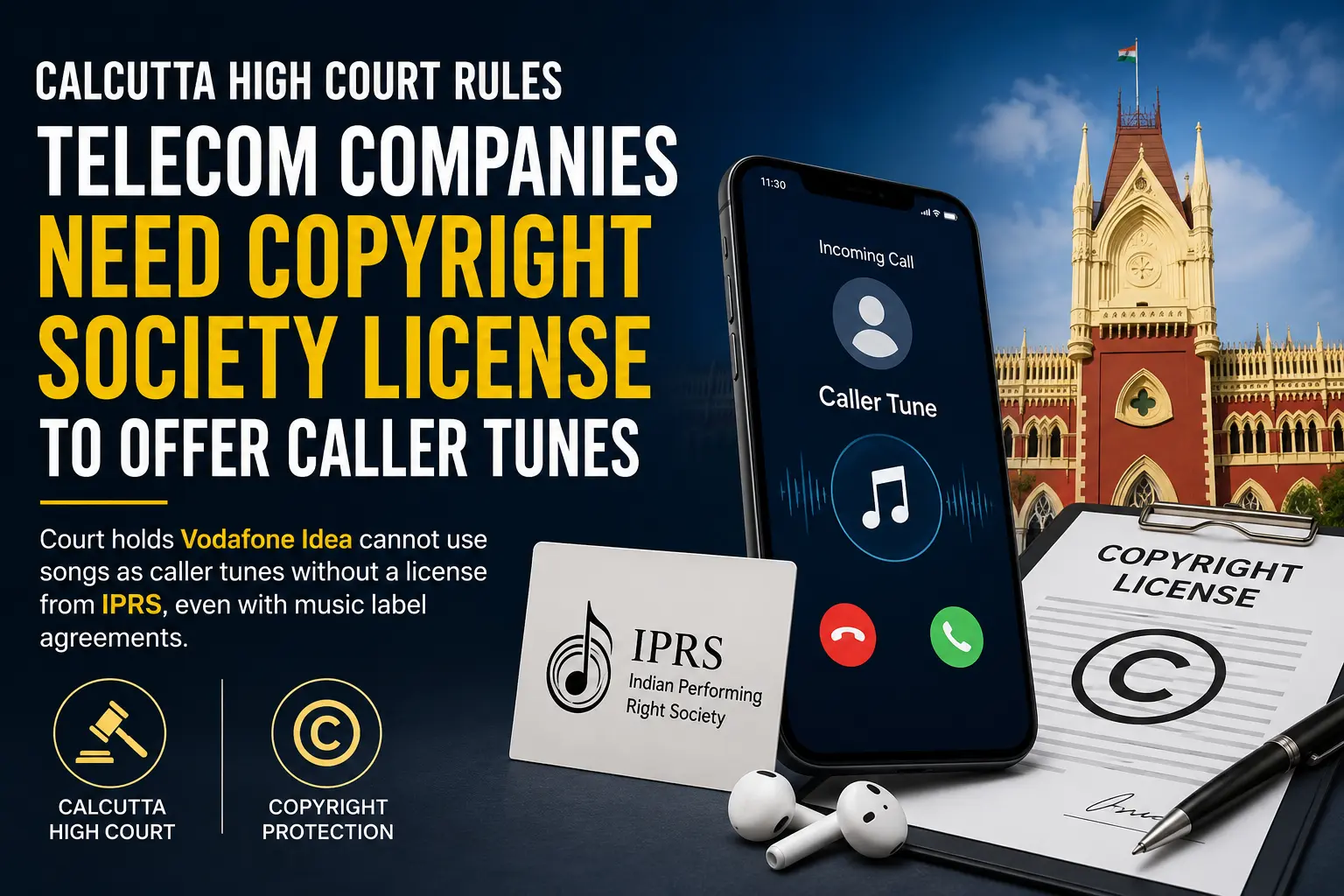
The Calcutta High Court has ruled that telecom companies cannot commercially use songs as caller tunes or ringtones without obtaining authorization from the Indian Performing Right Society (IPRS), even if they already hold licenses from music labels owning the sound recordings.
The judgment came in a dispute involving Vodafone Idea and IPRS over the telecom operator’s use of film and non-film songs in its caller ring back tone services. According to the Court, a license from a music label such as Saregama India Limited is not enough to commercially exploit the underlying musical compositions and lyrics contained in those recordings.
A Division Bench comprising Justice Debangsu Basak and Justice Mohammad Shabbar Rashidi observed that copyright in a sound recording and copyright in the underlying literary and musical works are separate legal rights under the Copyright Act. The Bench stated that telecom operators must independently obtain permission from IPRS before commercially using those underlying works.
Vodafone Idea had argued that its agreements with Saregama already allowed it to use the songs for value-added services such as caller tunes and ringtones. However, the Court rejected this argument and clarified that ownership of a sound recording does not automatically grant rights over lyrics and musical compositions created by authors and composers.
The ruling strengthens the position of lyricists, composers, and authors by reaffirming the royalty protections introduced through the 2012 amendments to India’s Copyright Act. The Court emphasized that creators of original literary and musical works continue to hold royalty rights whenever their works are commercially exploited outside cinema hall exhibitions.
Legal experts believe the judgment could have a major impact on the telecom and entertainment industries, particularly for companies offering caller tune and music streaming services. The decision reinforces that businesses must secure all necessary copyright permissions from relevant rights holders and copyright societies before monetizing music content.
The dispute is part of a larger legal battle concerning royalty payments and copyright ownership in India’s music industry. Earlier proceedings in the same matter had also examined whether telecom companies were liable to share royalties with authors and composers represented by IPRS (Source : Bar&Bench).