The Supreme Court on Wednesday instructed all States and Union Territories to strictly implement regulations requiring the installation of Vehicle Location Tracking Devices (VLTDs) and panic buttons in taxis and other public transport vehicles.
A Bench comprising Justices JB Pardiwala and KV Viswanathan expressed serious concern over the extremely low compliance rate, noting that less than one per cent of transport vehicles currently have vehicle tracking systems installed.
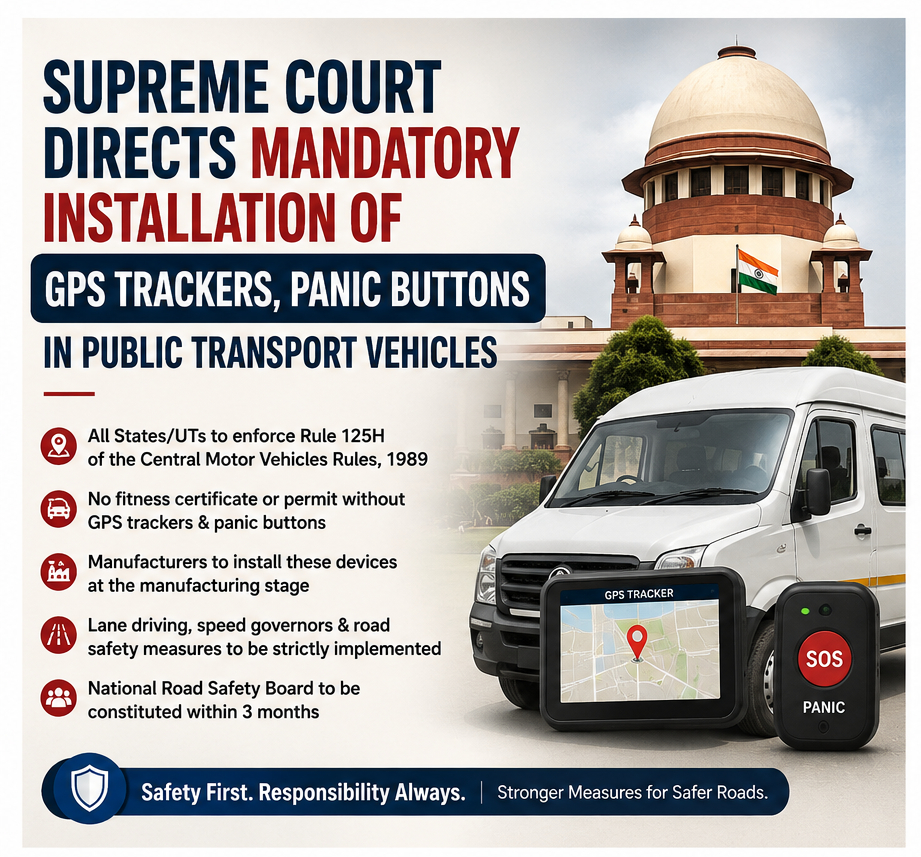
The Court directed all States and Union Territories to enforce Rule 125H of the Central Motor Vehicles Rules, 1989, by ensuring the installation of tracking devices and emergency panic buttons in both existing and newly registered public service vehicles within a fixed and verifiable timeline.
The Bench emphasized that these safety mechanisms are essential for the protection of passengers, particularly women, children, and senior citizens.
The apex court further clarified that no public service vehicle should receive a fitness certificate or transport permit unless it is equipped with Vehicle Location Tracking Devices and panic buttons. It also ordered that the installation details of these devices must be updated on the Vahan App.
Additionally, the Court supported the proposal that automobile manufacturers should install VLTDs and panic buttons at the manufacturing stage itself before vehicles are sold. To examine the practicality of this proposal, the Bench directed the Central Government to consult automobile manufacturers nationwide and submit a detailed report.
The directions were issued during the hearing of a matter related to the implementation of road safety measures across India.
During the proceedings, the Court also observed that India effectively lacks a proper culture of lane driving, which significantly contributes to road accidents. Stressing the importance of disciplined lane driving, the Bench remarked that improved lane compliance could substantially reduce accident rates and asked the Central Government to focus on the issue.
The Supreme Court also criticised several States for failing to submit compliance reports regarding the installation of speed-limiting devices, commonly known as speed governors, in vehicles. It reiterated that vehicle manufacturers are legally obligated to equip vehicles with such safety devices.
Further, the Court took serious note of the continued delay in establishing the National Road Safety Board despite previous directions and granted a final period of three months for its constitution.
The Public Interest Litigation was originally filed in 2012 by S Rajaseekaran, who highlighted the alarming number of road accidents in the country and sought coordinated measures to improve road safety infrastructure and post-accident medical care to reduce fatalities and injuries.
Over the years, the Supreme Court has repeatedly issued directions aimed at strengthening road safety standards across the nation. (Source : Jionews)